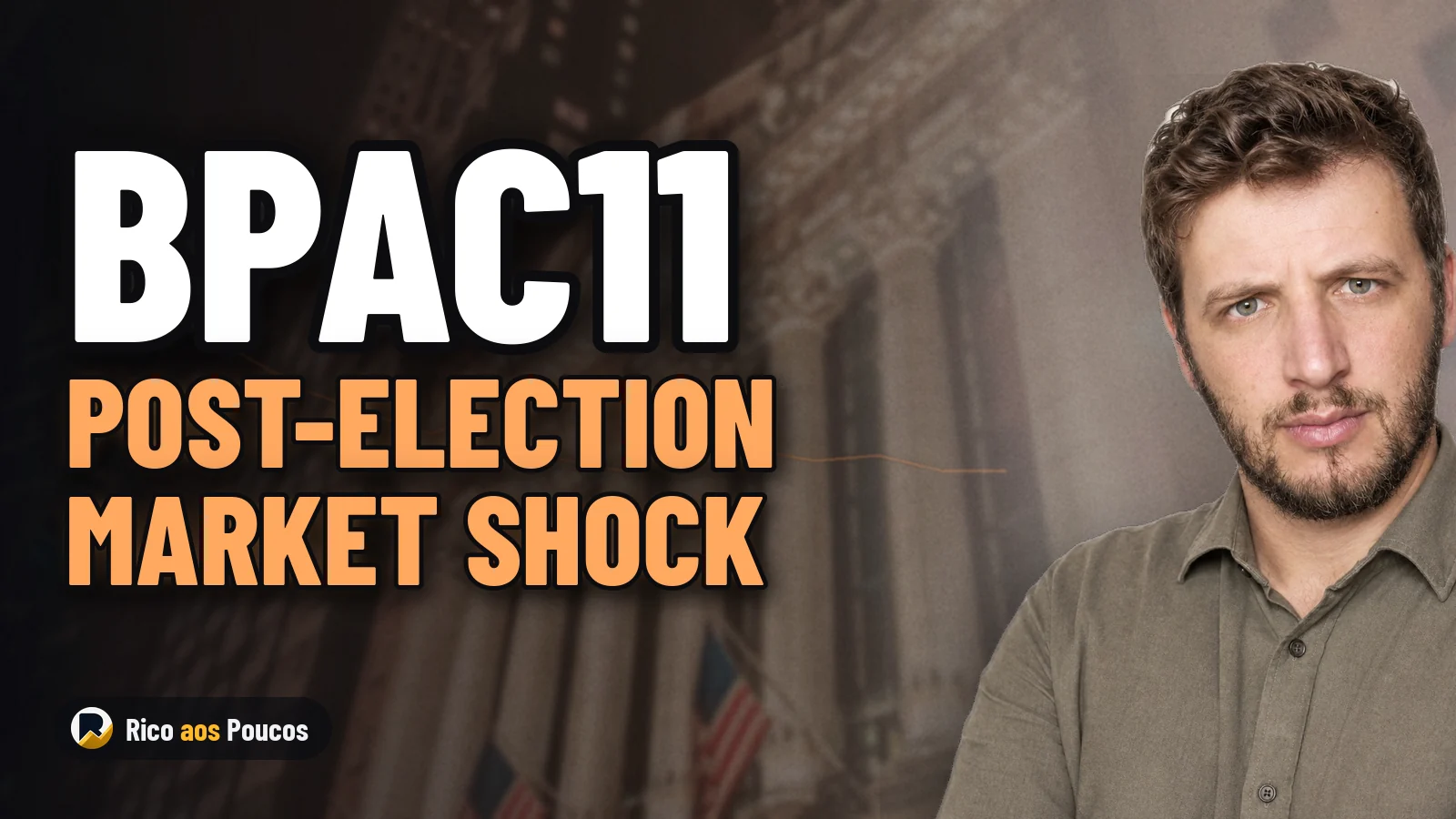


What Happened to BPAC11 and BBAS3 Shares After the Elections?
According to reports published by Money Times Economia and InfoMoney, the results of the first round of the presidential election outperformed polling projections, triggering an intense wave of optimism on the Brazilian stock exchange. The advantage secured by the right-leaning candidate abruptly altered perceptions of the country's fiscal risk, causing local assets with heavy exposure to the domestic economy to post extraordinary gains in a single session.
Amid this euphoria and widespread asset repricing, BPAC11 shares surged 27%, while BBAS3 shares posted a strong 11% advance, trading at R$ 26.33, according to InfoMoney data. The political shift and the perception that a reversal in the runoff, scheduled for late October, had become unlikely radically transformed the sentiment of institutional and foreign investors toward Brazilian assets.
This upward move across financial institutions occurred alongside a sharp repricing of local assets. The ballot tally revealed an electoral dynamic that caught the market off guard, altering fiscal and operational prospects for state-owned enterprises and investment banks, which opened sharply higher on the B3.
How Did the Election Results Shift Investor Bets?
According to information released by InfoMoney, the vote placed the market-friendly candidate in an advantageous position, leading by roughly 2 percentage points in the first round (47.03% to 45.16%). This scenario directly tested the strategies and positions of multi-market funds, which had maintained limited exposure to Brazilian equities through late September, just as returns began to reappear in investment portfolios.
Wall Street and local financial professionals interpreted the election outcome as a clear indicator of a lower probability of an upset in the final matchup. This more politically favorable landscape for fiscal adjustment immediately reduced the risk premium demanded by investors to hold capital in Brazilian companies, unlocking a substantial flow of capital into the stock market and driving the exchange rate downward amid strong foreign inflows.
The price reaction reflected an urgent need for fund managers and investment funds to adjust their allocations. Because equity exposure had been reined in due to pre-election uncertainty, the confirmed election results sparked a buying rush to rebuild positions, most strongly boosting the most liquid stocks with the highest sensitivity to the domestic macroeconomic cycle.
What Is the Relationship Between Long-Term Interest Rates and Bank Performance on the B3?
The upward move in stock prices finds strong technical backing in a Morgan Stanley study covered by InfoMoney, which analyzed the historical relationship between financial sector assets and long-term interest rates over the past decade. The international bank concluded that all financial stocks in its sample share a historically negative relationship with long-term Brazilian interest rates, meaning these securities tend to post consistent gains when long-term rates decline.
For Banco do Brasil, the sensitivity calculated by the study is quite pronounced: historically, a 100-basis-point drop—equivalent to 1 percentage point in long-term interest rates—has been associated with an approximately 13% gain in the price of BBAS3 shares. This level of sensitivity placed the state-controlled institution ahead of other major traditional banks analyzed in the same statistical survey.
In addition, the survey indicated that other heavyweights in the national financial system, such as Bradesco with BBDC4 shares and Santander Brasil with SANB11 shares, also show a strong correlation with yield curve fluctuations. However, Banco do Brasil stood out for the potential magnitude of its response to changes in the country's long-term financial conditions.
What Does the Jump in BTG Pactual (BPAC11) and Banco do Brasil (BBAS3) Mean for Investors?
For retail investors, the strong post-election rally demonstrates the extreme volatility and speed with which the market reacts to shifts in the political and macroeconomic landscape. The sharp gains in BPAC11 and BBAS3 shares show that securities sensitive to interest rates and fiscal risk are the first to capture optimism when the country's expectations are repriced.
However, analysts consulted in the reports emphasize that moves driven by electoral euphoria demand heightened caution. Buying assets after double-digit gains in just a few sessions raises the risk of exposure to short-term corrections if new polls or noise emerge in the political debate leading up to the runoff scheduled for late October.
Consequently, investors should evaluate whether their equity allocations are properly balanced within a long-term strategy, avoiding decisions based exclusively on the heat of daily political news and prioritizing diversification between fixed income and equities.
What to Monitor Moving Forward in the Electoral and Market Landscape?
From here on, the financial market's absolute focus will center on runoff campaign developments and the release of new voting intention polls. Any sign of the gap narrowing between the candidates could spark additional volatility in stock prices and the futures yield curve.
Another fundamental point to monitor closely is the behavior of inflation and public accounts, since the sustainability of fiscal optimism will depend on concrete measures and rhetoric aligned with fiscal responsibility from the presidential contenders.
Finally, investors need to track foreign capital flows on the B3 and the repositioning of multi-market portfolios, factors that will continue dictating the pace and direction of major bank prices and the Ibovespa in the coming weeks.
<