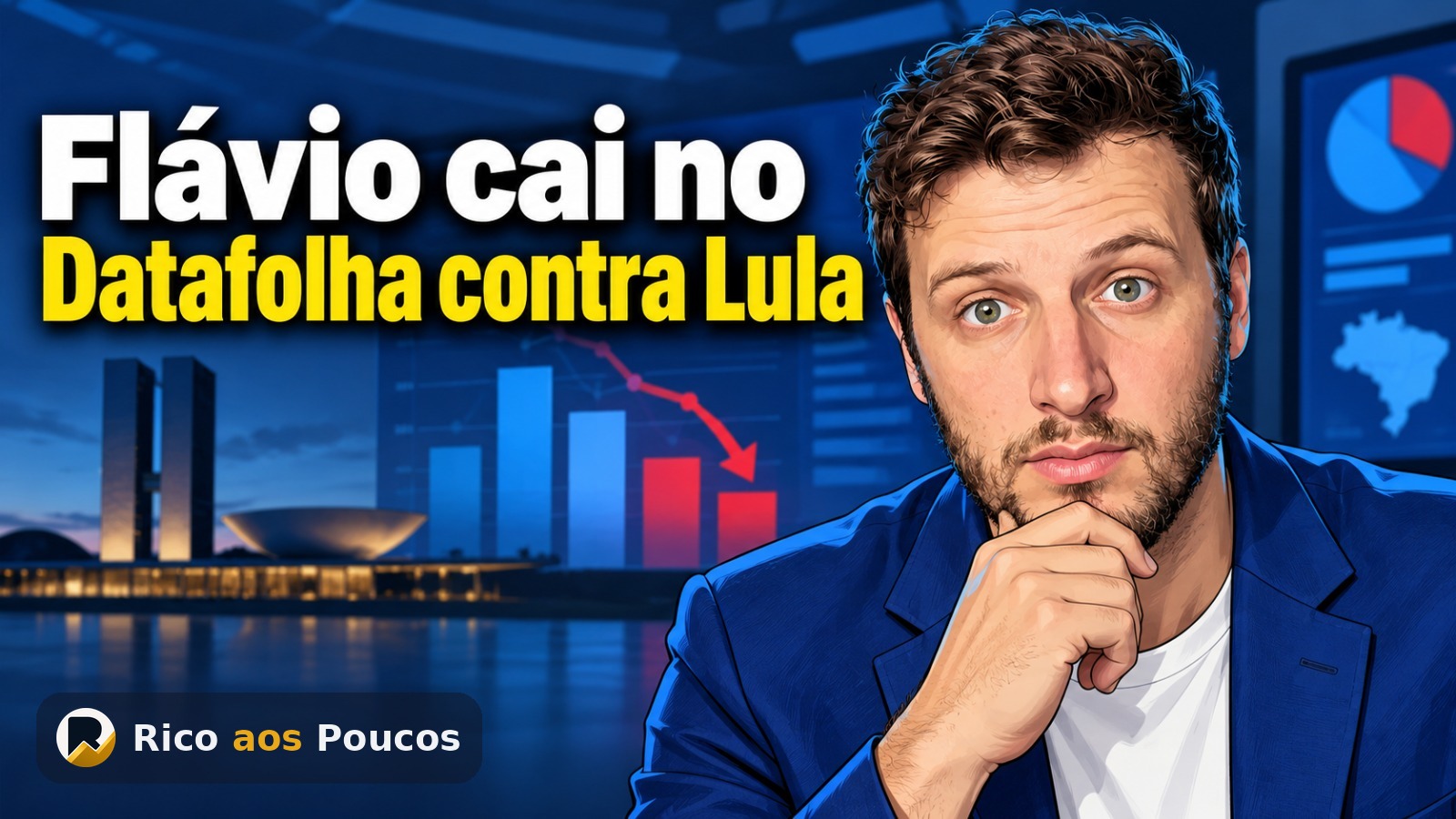
- Datafolha found that Flávio Bolsonaro ticked downward in a direct simulation against President Luiz Inácio Lula da Silva.
- The race remains tight, preserving the historical divisions solidified by income level, geographic location, and religious faith.
- For investors, the continuation of a polarized landscape without a runaway favorite sustains volatility across interest rates and exchange rates.
The latest Datafolha round indicates that Senator Flávio Bolsonaro experienced a downward tick against Lula, keeping the electoral board balanced and risk premiums under observation across trading desks.
What Did the Datafolha Poll Reveal About the Race?
Flávio Bolsonaro ticked down in a head-to-head matchup with Lula, according to Datafolha figures published by InfoMoney. The survey confirms that the presidential race remains wide open for either pole, with voter bases deeply entrenched across social strata.
The poll details that this balance of power relies on the electorate's customary cleavages. While one pole maintains a broad advantage in lower-income brackets and specific regions, the other finds support in specific middle-class segments, geographic clusters, and confessional groups.
This layout shows that neither political force has consolidated a breakaway lead. Movements within the margin of error or short-term fluctuations reinforce the perception that the campaign will demand moderation and a fierce fight for centrist votes.
Socioeconomic division remains the sharpest line of preference among candidates.
The voting map mirrors the territorial polarization observed in recent electoral cycles.
Faith-based groupings maintain solid loyalty with low permeability to migration.
Why Does the Financial Market React to Polls So Far in Advance?
Institutional investors price in long-term expectations, particularly regarding fiscal policy management and public debt control. With each round of public opinion polling, analysts and fund managers recalibrate the probability of continuity or a transfer of power.
When a poll signals uncertainty or a tight race, the immediate reflection is not a unidirectional bet, but rather an increase in the discount rate. Uncertainty regarding macroeconomic orientation over the coming years forces market participants to demand higher returns to hold long-term Treasury bonds.
Furthermore, the behavior of political leaderships in polarized campaigns tends to increase the temptation for electoral spending. If the opposition demonstrates competitive pressure, the incumbent administration may be pushed toward populist measures; if the incumbent leads comfortably, the pressure for fiscal rigor eases differently.
A balanced campaign forces rhetoric centered on budgetary responsibility and moderation, reducing interest rate premiums.
Pressure in the polls stimulates promises of subsidies and unchecked expansion of public spending, making credit more expensive.
What Factors Should Investors Watch Moving Forward?
Flávio Bolsonaro's fluctuation shows that the opposition's ceiling depends on alliances, while Lula's resilience indicates that the political apparatus and popular name recognition continue to carry weight. Given this reality reflected by electoral coverage sources, investors should not trade daily headlines, but rather track objective variables:
- Signs of budgetary responsibility: formal commitments to fiscal anchors and limits on public debt growth.
- Names floated for economic posts: technicians respected by the market provide exchange-rate predictability and lower risk aversion.
- Worsening solvency perception: promises of permanent spending without matching revenues destabilize fixed-rate bonds and inflation-linked securities.
- Institutional stress risk: fierce challenges and inflammatory rhetoric drive foreign capital outflows away from the B3.
How Can You Protect Your Wealth While the Electoral Landscape Takes Shape?
The golden rule during periods of political uncertainty is to avoid binary positions. Trading on the exact outcome of an election months in advance is speculation with a very high error rate, not wealth management.
A defensive portfolio for retail investors focuses on real returns and liquidity. Floating-rate bonds indexed to the CDI continue to offer high yields without exposure to long-curve volatility. Meanwhile, inflation-linked bonds protect purchasing power against excessive fiscal imbalances.
If you hold stocks, real estate funds (FIIs), or fixed income, the Datafolha survey is a reminder that political noise will remain high. Instead of churning your portfolio over a single point of fluctuation, increase your contributions to assets with consistent cash generation, protect a portion of your resources against inflation, and keep your cash reserve intact.
Watch out for short-term noise: marginal swings in electoral polls generate flashy headlines in the press, but rarely justify a hasty liquidation of value-oriented assets. Maintain your focus on the fundamentals of the companies and real estate funds in your portfolio.