

"Does this affect me?" Yes — and not through gasoline. You don't ship a barrel of oil through the Strait of Hormuz, but your money absorbs the shock through three inescapable channels: the dollar surges as a safe haven, imported inflation pushes Brazil's IPCA (consumer price index) higher and with it the Selic (Brazil's benchmark interest rate) and CDI (overnight interbank rate); and the stock market splits in two — commodity exporters rise while importers take the hit. If you hold Brazilian reais, FIIs (Brazilian REITs), or domestic stocks, Iran's announcement is already moving your asset prices before a single barrel stops flowing. This piece breaks down each channel and shows where the recommended portfolio stands.
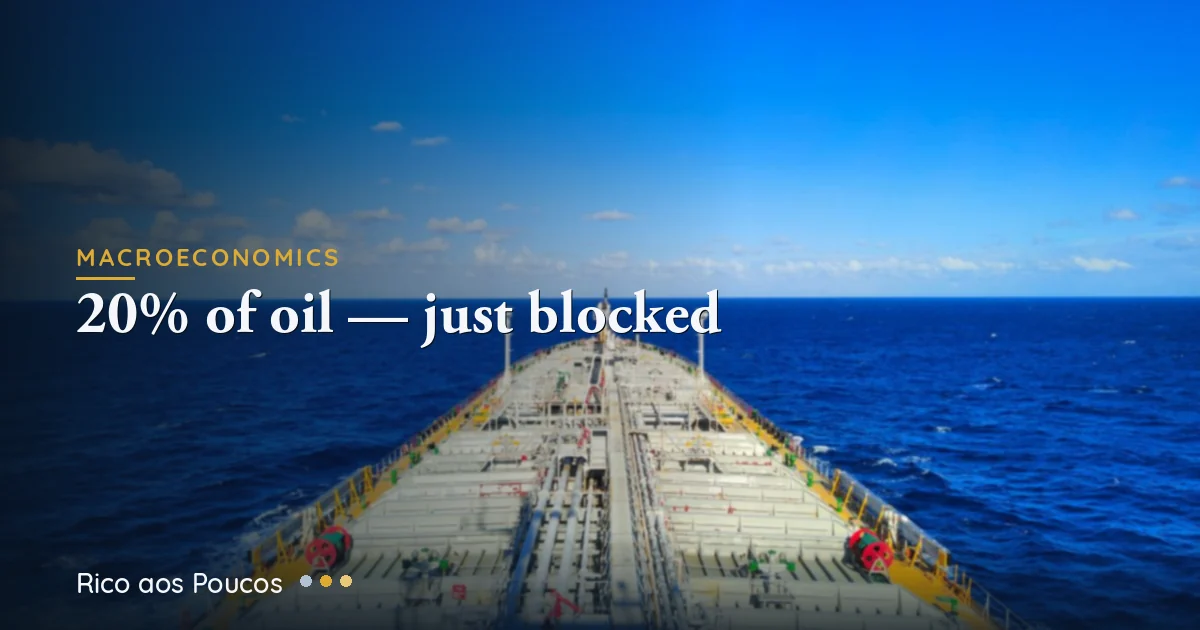
Iran announced it would close the Strait of Hormuz in retaliation for U.S. military strikes, threatening to target any vessel attempting to cross the passage. This is not a distant regional skirmish: Hormuz is the single most critical chokepoint in the global energy system. Through that corridor — barely 33 kilometers wide at its narrowest — flows roughly 20% of all oil consumed worldwide and approximately 30% of globally traded liquefied natural gas (LNG) by sea. When that pipe is threatened, markets don't wait to see if the blockade materializes — they price in the risk immediately.
Channel 1 — Oil: the shock that sets everything else in motion
Even a partial or short-lived closure of Hormuz constitutes a classic supply shock: demand for oil stays constant while available supply shrinks overnight. The mechanical outcome is a violent spike in both Brent and WTI crude. What distinguishes this from a gradual price rise is speed — futures markets immediately bake in a war premium, and barrels trading at US$70-80 can jump to triple digits within sessions, depending on how long markets believe the blockade will last.
The critical insight for sophisticated investors is that this is a shock no central bank can neutralize with interest rates. Raising rates does not put more oil on the market. That is precisely why the price signal propagates cleanly through the entire cost chain before any monetary policy response kicks in — and it is exactly that impotence of the Fed and Brazil's Central Bank that makes the event so dangerous for portfolios caught on the wrong side.
Channel 2 — Imported inflation, IPCA and Brazilian interest rates
Expensive oil does not stay contained in fuel prices. It bleeds into freight for everything that moves, into industrial production costs, fertilizers, plastics and energy. In Brazil, this hits the IPCA (Brazil's official consumer price index, equivalent to CPI) through two simultaneous channels: a direct passthrough to fuel prices and a slower indirect passthrough via the cost structures of the entire supply chain. An IPCA driven up by external shocks places Brazil's Central Bank in the worst possible position — inflation rising without any excess domestic demand to justify tightening.
The practical consequence for fixed income is straightforward. With IPCA elevated and expectations becoming unanchored, markets price in higher rates for longer, and the CDI (the overnight interbank rate that benchmarks most Brazilian fixed-income products) tends to stay elevated or move higher. For investors holding cash earning 100% of CDI or more, this looks like good news on the surface: the reserve compounds faster. But it is nominal yield sheltering against inflation that has also risen — the real return is smaller than the headline suggests. Investors who confuse a fat nominal CDI with genuine wealth accumulation fall into the classic monetary illusion of an inflationary environment.
Channel 3 — Paper FIIs: the IPCA+CDI paradox
This is where the scenario becomes counterintuitive — and separates investors who understand from those who repeat. Paper FIIs (Brazilian mortgage-backed REIT funds) hold portfolios of CRIs (real estate receivables certificates) indexed to IPCA+ or CDI+. When IPCA and CDI rise, the cash flow from those CRIs rises with them — meaning the dividends distributed by paper FIIs tend to increase, and the current dividend yield climbs. To a unitholder looking only at monthly income, it can feel like a windfall.
The trouble lies in present value and credit risk. Two mechanisms simultaneously push unit prices lower even as yield rises. First: when the economy's discount rate increases (higher real interest rates), the present value of future CRI cash flows falls — fixed-income securities marked to market lose price when rates rise, and this reprices the fund unit. Second: an inflationary and recessionary shock increases the default risk of CRI borrowers — if markets begin pricing in higher credit risk in the underlying portfolio, they demand a larger premium and the unit price drops. The result is a fund that may pay more per month yet still see its unit price fall. High yield alongside falling prices is not automatically an opportunity: it is the market saying risk has risen in tandem. Correct interpretation requires examining the credit quality of each fund's portfolio, not the DY figure in isolation.
Rule for paper FII unitholders in this environment: DY rising while the unit price falls signals risk repricing, not a guaranteed bargain. What protects you is credit quality within the fund's portfolio — low LTV, borrowers resilient to inflation, solid real guarantees. A fat yield from a fund with a fragile credit book is a risk premium that can turn into a loss.
Channel 4 — Exchange rate: why the dollar moves first
In every episode of geopolitical stress, global capital flows into the dollar as a safe-haven asset — and that dynamic is doubly powerful when the shock involves a commodity priced in dollars, like oil. For Brazil, an emerging market economy with risk-on exposure, the combination is harsh: capital outflows from emerging markets, flight to hard currency and deteriorating global risk appetite all push the real lower. The dollar tends to gap up on the open and remain under upward pressure for as long as the tension persists.
This is the fastest-moving channel of all. The exchange rate has already moved before oil feeds through to inflation and inflation feeds through to CDI. That is why a currency hedge established before the event is not a speculative bet — it is the protective layer that captures precisely the first impulse of stress, at the exact moment when every other part of the portfolio is absorbing the blow.
Channel 5 — IBOV: the stock market splits in two
Brazil's benchmark stock index (IBOV), traded on the B3 exchange, does not respond as a single block to an oil shock. It divides along sectoral lines. On one side, commodity exporters — oil companies, miners, pulp and paper producers, parts of agribusiness — tend to benefit: they sell in dollars, receive more reais per unit exported and ride the higher international price. On the other, importers and domestically dependent businesses — retail, airlines, manufacturers that import inputs, energy-intensive companies — suffer from higher costs, compressed margins and demand weakened by inflation.
Real estate and logistics sectors deserve specific attention. Logistics FIIs face double exposure: higher freight costs pressure tenants' operating margins, but nearshoring trends and strong warehouse demand can sustain occupancy. Shopping-center FIIs are hurt on the consumption side — inflation erodes disposable income and high interest rates raise consumer credit costs, cooling sales and, ultimately, variable rent revenue. The net balance for IBOV in a Hormuz shock tends to be negative overall, because the weight of importers and domestic consumer exposure in the index and the broader economy outweighs the relief from exporters.
How the recommended portfolio holds up
The current Rico aos Poucos portfolio allocation was not built for this specific event, but the protective logic underpinning it is exactly what a Hormuz shock tests. Each position is worth reading through the five channels above.
| Position | Weight / outlook | Reading under a Hormuz shock |
|---|---|---|
| Dollar | 25% — Bullish | Strongly favored. This is the fastest channel of stress; currency exposure captures the first safe-haven impulse while the rest of the portfolio absorbs the blow |
| Real estate | 25% — Bullish | Real assets protect against inflation over the long run, but the higher rates that come with the shock raise credit costs and weigh on near-term liquidity |
| Cash | 15% — Bullish | Favored. A higher CDI compounds the reserve faster, and any dollar-denominated portion captures both FX and rate moves simultaneously — plus dry powder for opportunities in the downturn |
| FIIs (Brazilian REITs) | 10% — Neutral | Ambiguous. Paper funds may see higher DY, but units are pressured by rates and credit risk; logistics and shopping-center funds feel the consumption squeeze. Selectivity matters more than sector |
| IBOV | 10% — Bearish | Bearish view validated. Low weight limits the damage; the index in aggregate tends to suffer more from importers and domestic consumption than it gains from exporters |
| TLT | 10% — Neutral | Under pressure. An inflationary shock pushes U.S. long-term rates higher and compresses long Treasury prices; not the moment to add duration |
| IPCA+ | 5% — Neutral | Conceptually favored by inflation indexation, but mark-to-market suffers in the short run from rising real rates |
The overall structure holds up well under scrutiny. The combined 40% in dollar exposure and cash positions nearly half the portfolio on the right side of both a currency shock and a rate shock. The underweight in IBOV and the complete absence of S&P 500 and Bitcoin limit exposure to the assets that suffer most in a risk-off panic. The area to watch is the FII and TLT block — not because they are wrong-footed, but because each demands a careful read: for paper FIIs, the credit quality of the underlying book determines whether you have an opportunity or a trap; for TLT, the scenario argues against adding duration while long rates remain under pressure.
Verdict: Dollar and cash holders ride out the shock; domestic-risk concentration is where the damage lands
What the event actually does: a Hormuz closure is a supply shock that no central bank can offset with rate moves. It propagates cleanly — oil spikes, imported inflation rises, rates stay higher for longer, and the dollar gaps up as a refuge. The stock market splits between commodity exporters that benefit and importers that are hurt, with the aggregate IBOV balance skewing negative.
For portfolio followers: the combination of 25% in dollars and 15% in cash already positions the investor on the right side of the two fastest-moving stress channels — exchange rate and interest rates. No reactive trade is needed; the protective thesis holds and the cash reserve provides dry powder for opportunities that emerge in the sell-off.
For FII (Brazilian REIT) unitholders: resist the lazy read of the DY. In a paper fund, yield rising while the unit price falls is risk repricing, not an automatic bargain — credit quality within the portfolio is what offers protection. In brick-and-mortar funds, logistics and shopping centers feel the consumption squeeze. Selectivity is worth more than broad sector calls.
What to monitor: the actual duration of any blockade (the factor that separates a fleeting spike from a sustained high-oil-price regime), Brent behavior, the dollar's reaction and moves in Brazil's short DI rates, and foreign investor flow signals from emerging markets. It is the persistence of the event, not the announcement itself, that determines the scale of the damage.
Sources
- InfoMoney (World) — Iran announces closure of the Strait of Hormuz after U.S. attacks — news report that grounded the research for this article.
Data and geopolitical context reflect information available through June 11, 2026 and are subject to rapid change. The strategic analysis and its relation to the recommended portfolio represent editorial commentary by Rico aos Poucos and do not constitute investment advice.
