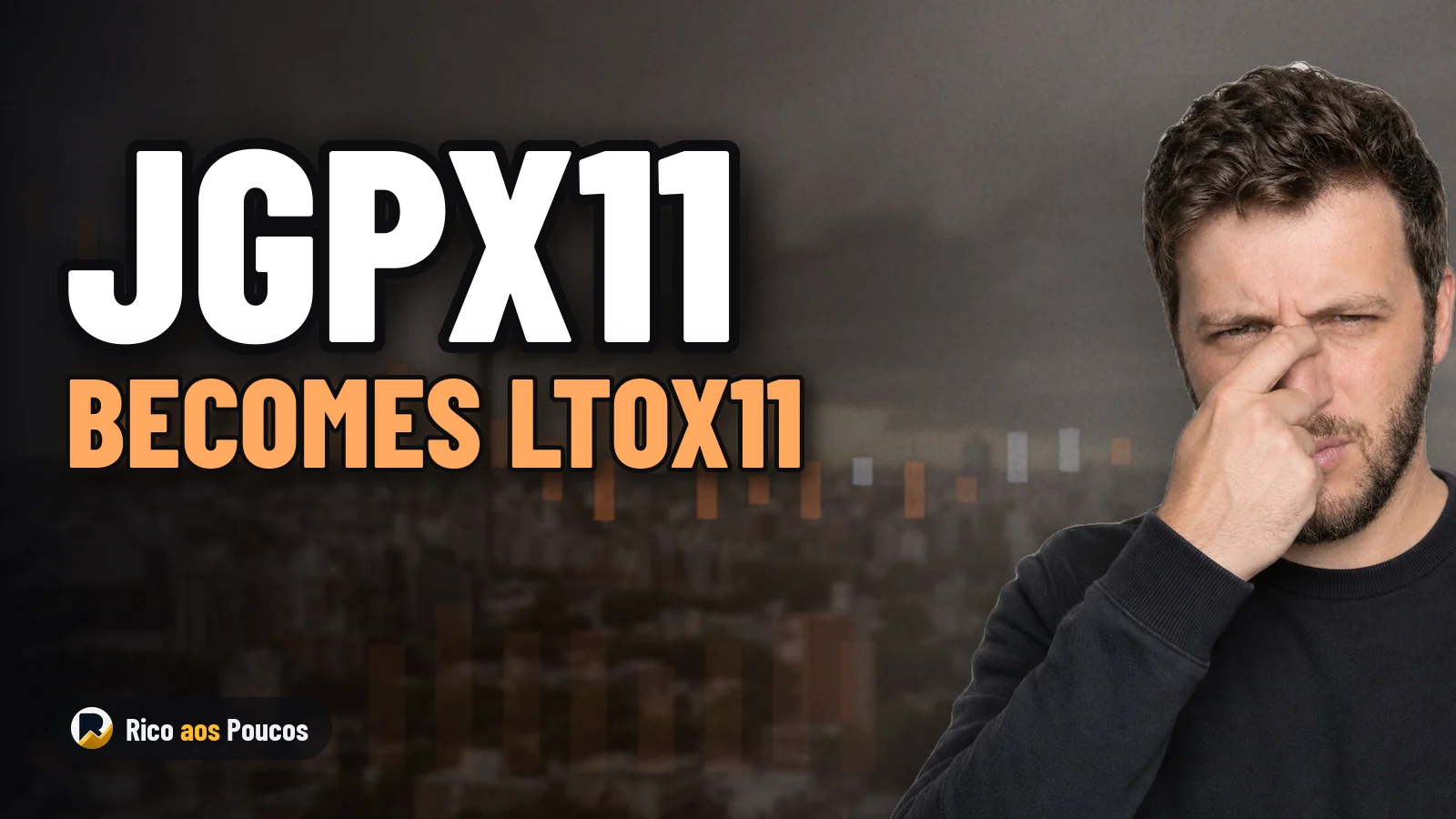


No, JGPX11 is not cutting your distribution—the fund announced it will pay at least R$ 1.00 per unit per month through June 2027. The catch lies in how that R$ 1.00 will be paid: the manager itself warns that in the early months, most of the payout will come from capital amortization, meaning the return of your own money rather than income generated by the portfolio. In the same November package, the fund marked down distressed credit positions (lowering the book value per unit from R$ 95.77 to R$ 93.44) and changed its name: JGPX11 will now trade under the ticker LTOX11.
Is JGPX11 Cutting the Dividend?
There is no cut in the nominal amount. Starting with the distribution for November 2026 (paid in December) and running through the end of the fund's fiscal year in June 2027, the manager intends to distribute at least R$ 1.00 per unit per month. The new element is the mechanism: the policy combines earnings and, when those are not sufficient, capital amortization. The October distribution (paid in November) is not subject to this rule.
This distinction matters for investors seeking regular income. Earnings represent profits generated and distributed by the fund, which are exempt from income tax for individual investors. Amortization is the return of part of the capital you invested: it reduces the book value per unit without changing the number of units you hold, and it should not be viewed as profit. The manager explicitly stated that, in the early months, most of the payments are expected to occur via amortization due to the accounting effects of credit markdowns detailed below.
In plain English: for a period, part of the R$ 1.00 hitting your account will be your own money coming back—not new income. The monthly check stays the same, but the underlying assets supporting that check shrink with each amortization. That is why this news deserves attention, even without a cut in the amount paid.
Why Did Book Value Drop from R$ 95.77 to R$ 93.44?
On November 5, the administrator reviewed the valuations of the portfolio's five distressed credit assets, which accounted for approximately 24% of net asset value as of October 30. Following the review, it marked down three of them (Prime Agro, Solubio, and Belagrícola) and maintained the valuations for Agrogalaxy and Lavoro. The estimated negative impact on net asset value was R$ 5 million, equivalent to 2.4% of total equity.
This adjustment hits November's accounting results and, according to the fund, does not affect October closing figures. However, it explains the amortization policy: with markdowns compressing accounting earnings, the manager is resorting to capital amortization to sustain the promised R$ 1.00 per unit. It is worth noting that the credits undergoing restructuring (Belagrícola, Prime Agro, and Lavoro in judicial or extrajudicial reorganization, Solubio renegotiated, Agrogalaxy monitored) remain the primary risk for further markdowns in the fund.
How Was October's Performance?
Looking at the month in isolation, October was stronger than September. Earnings per unit rose to R$ 1.00, fully covering the R$ 1.00 distribution—a 100% payout ratio. In September, the fund generated only R$ 0.85 while paying R$ 1.00, drawing on reserves to cover the gap. Year-to-date (YTD) accumulated earnings rose from R$ 6.64 to R$ 6.79 per unit, helped by a less negative mark-to-market adjustment during the month.
An honest reading: October itself was a balanced month. The concern lies ahead—the combination of November accounting markdowns and the commitment to pay the distribution floor via capital amortization changes the quality of what unitholders receive.
Why Is JGPX11 Changing to LTOX11?
The ticker change is the result of a corporate transition rather than an operational one. The manager's corporate name changed from JGP Gestão de Crédito Ltda. to Leto Asset Management Ltda. (according to a material fact disclosure dated November 5, 2026). Consequently, the fund is updating its name and trading ticker on the B3: JGPX11 will become LTOX11, with the trading name "LETO FIAGRO LISTADO," within five business days of the announcement. The number of units and each investor's position remain unchanged—only the ticker symbol in your brokerage account will shift.
Is the Portfolio Getting Better or Worse?
The average quality of the portfolio improved over the past year, which is the positive side of the story. The share classified as high quality and cash rose from 36.0% (October 2025) to 56.2% (October 2026), while the portion in restructuring fell from 21.0% to 17.0% over the same period. Excluding distressed and renegotiated assets, the "clean" portfolio accounts for 75.8% of net asset value.
| Risk class (% of NAV) | 10/31/2025 | 10/30/2026 |
|---|---|---|
| High quality and cash | 36.0% | 56.2% |
| Medium risk | 43.0% | 26.8% |
| In restructuring | 21.0% | 17.0% |
At the October close, 95% of the fund's assets were invested across 36 agribusiness receivables certificates (CRAs), 1 Fiagro, and 1 credit rights investment fund (FIDC), with an average spread of CDI plus 2.47% per year, a duration of 1.9 years, and 5.18% in cash. In October, the manager acquired a CRA issued by JSL S.A., while a CRA from Café Brasil left the portfolio as part of a strategy to shift toward higher-credit-quality issuers.
Your monthly check remains R$ 1.00 per unit, but part of it will represent a return of your capital for a few months—so do not confuse the deposit with pure income. Book value per unit drops to R$ 93.44 following the markdowns, and the ticker changes to LTOX11 in your brokerage account. In short: cash flow has been preserved, while the quality of what you receive and the asset backing behind it have deteriorated at the margin.
What to Monitor Going Forward
How much of the R$ 1.00 is earnings versus amortization—upcoming distribution reports will break down the two portions. The larger the amortization slice, the more the fund is returning capital rather than generating income.
New markdowns on distressed credits—Belagrícola, Prime Agro, Lavoro, Solubio, and Agrogalaxy remain in reorganization or renegotiation processes. Any deterioration could require further adjustments to book value.
The transition to LTOX11—check whether your brokerage has updated the ticker and trading name to avoid confusion with orders and statements.
The Verdict
JGPX11 (future LTOX11) bought short-term predictability by establishing a distribution floor of R$ 1.00 per unit, but paid for it with the quality of the distribution: for several months, a large part of the payout will be capital amortization, and book value per unit is already dropping to R$ 93.44 due to credit markdowns. The portfolio improved overall over the course of the year, with a larger share of high-quality assets, but investors need to view the fund for what it truly is now: a credit Fiagro that still carries distressed assets and, in the short term, sustains its yield by returning part of its own capital.
