Update — 17/06/2026
O CRI Five Senses SR (PL 6,06%), which already accumulated an extrajudicial notification from Oliveira Trust for lack of transfer (18/03/2026), entered into waiver from June/2026 to complete the works of the resort. Impact on ARRI11 yields should persist until October/2026, when the fund manager of the project projects the completion of the works (source: RG of the URPR11, FII that shares the same CRI). This represents another pressure vector on the already reduced DPS to R$ 0,07 — the new cut scenario before the 3Q2026 became more likely.
Direct answer: will I take another cut?
Possible, but not right. The management of ARRI11 has approximately R$ 4,64 million in cash and fixed income — the equivalent of about 3 months coverage to the current R$ 0,07. DPS The portfolio is mostly IPCA+ (80,5%) and the fund manager’s thesis is that the monetary correction scrutinized in the CRIs between April and June 2026 will unlock sufficient financial results to support the R$ 0,07 — and perhaps resume the R$ 0,09.
The risk exists: if the monetary correction does not materialize (or is partially offset by additional default, negative marking or performance expense), a new cut for the range of R$ 0,05–R$ 0,06 is a plausible scenario before the 3Q2026.
The P/VP of 0,61 (40% discount on the equity value of R$ 8,38) already pricing much of that risk — but not all. The background also carries a structural problem with AROK FII (11,5% of the PL), which is not listed and administered by the same fund manager.
Recommended position: Maintain for those who already have, by weight up to 5% from FIIs portfolio. It is not aggressive purchase until the PSD regime stabilises for at least two consecutive quarters with positive financial coverage.
What the 1Q2026 really revealed
The Quarterly Report delivered to the CVM on May 13, 2026 (ID 1188515) is the document that reorganizes the reading on ARRI11. . Not by accounting result — this came in R$ 5,60 million, apparently healthy number. The point is in the detailing of the regime box, specifically in Item L of the report, where the remaining income to pay appears.
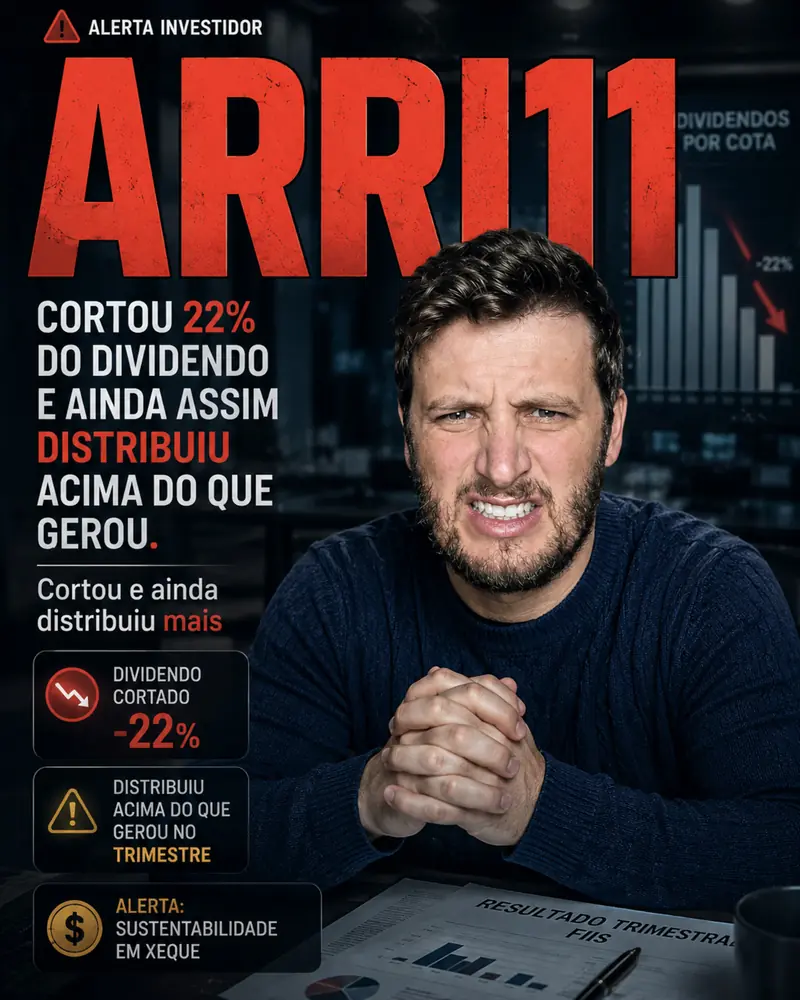
The value is negative in R$ 493 thousand. In direct language: In the three months ended in March 2026, the fund distributed to the unit holders R$ 493 thousand over what effectively generated as a net financial result. The net financial result of the quarter was R$ 4,69 million. The accumulated distribution was R$ 5,18 million. The difference came out of the accumulated cash from previous quarters, when the fund generated above R$ 0,09 and distributed R$ 0,09.
The distance between the accounting result (R$ 5,60 million) and the financial one (R$ 4,69 million) also deserves careful reading. The difference of R$ 911 thousand comes mostly from R$ 2,82 million in fair value adjustment of Securities and Securities (TVMs) — unrealised revenue, accounting, which does not become cash or dividend until the assets are sold or amortized. Looking at just the accounting result creates the illusion of comfortable coverage that the cash regime denies.
What the investor needs to understand: the CVM allows to distribute 95% of the accounting result, but what pays the unit accounts in the long term is the financial result. When the second is below the first structurally, the distribution becomes cash financing — sustainable for a few months, unsustainable for years.
The deficit in numbers: distributed above the generated
Monthly decomposition helps to understand the size of the problem. With accumulated distribution of R$ 5,18 million in three months (January, February and March 2026), the monthly average per unit was around R$ 0,083. The net financial result, divided by the same number of units, indicates generation of approximately R$ 0,075 per month.
| Indicator 1Q2026 | Value | Reading |
|---|---|---|
| Cumulative distribution | R$ 5,18 Mi | ~R$ 0,083/unit/month |
| Net financial result | R$ 4,69 Mi | ~R$ 0,075/unit/month (real capacity) |
| Accounting result | R$ 5,60 Mi | includes R$ 2,82 Mi at fair value (not cash) |
| Quarter Cash Deficit | R$ 493 thousand | difference between distributed and generated |
| Box + RF available | R$ 4,64 Mi | ~3 months mattress to R$ 0,07 DPS |
The reading of management for this deficit was explicit in the report: "less result in capital gain". The fund had added to the recurrent income of the CRIs some one-off gains with paper sales (wallet giro), and this component disappeared in the quarter. The justification for cutting R$ 0,09 to R$ 0,07 from March 2026 — after 17 consecutive months at the R$ 0,09 level between September 2024 and February 2026 — comes out exactly from there.
The current R$ 0,07 represents about R$ 1,45 million monthly distribution (20,73 million units × R$ 0,07). If the net financial result stabilises in the quarterly R$ 4,69 million seen in 1Q2026 (about R$ 1,56 million/month), there is coverage — but with minimal margin. Any adverse event eliminates the day off.
The portfolio you hold (or not)
The generation engine of ARRI11 it is a portfolio of 20 CRIs distributed in 8 states, 7 securitizers and 5 sectors. The average load is IPCA+11,65%, with 80,5% indexed to IPCA+ and 19,5% to CDI+. In terms of credit risk, 86% of the portfolio is classified as High Yield — a profile consistent with the fund's historical thesis since the IPO in October 2019, when it was still called Atrio REIT.
The resuming thesis of the DPS is mathematics: 80,5% of the portfolio linked to IPCA+ should, in theory, capture inflation measured in previous months and convert into financial revenue in the following months via scrutinized monetary correction. The accumulated IPCA from the last twelve months until April 2026 runs near 4,5–ZQ1ZQX, and this correction tends to be recognized in revenue in the following quarters — a phenomenon that management projects for the interval between April and June 2026.
If the projection is confirmed, the net financial result of the 2T2026 should be materially above the R$ 4,69 million of the 1T — possibly between R$ 5,2 million and R$ 5,8 million, which would cover the R$ 0,07 with slack and allow for cash reconstruction. If not confirmed, the R$ 4,64 million mattress covers about three months of current DPS before forcing management to a new cut.
The decisive factor: It is not the IPCA itself — it is the real spread between the recognised inflation in the CRIs and the effective default of the portfolio. Nominal load IPCA+11,65% only becomes cash revenue if the debtors pay. Additional provisions or further delays consume the spread before it reaches the unit.
Inside the wallet, two points deserve isolated attention. The first is the CRI Ipatinga, default since July 2022, with R$ 2,02 million exposure (1,17% PL). This asset is already provisioned — the accounting impact has been recognized, but any recovery in the future enters as gain. The second is the FIDC Diamante (3,4% of the PL), which received a caveat from PwC in the year 2024 and had this caveat resolved in 2025, with the auditor's opinion being cleaned again — a positive sign of governance.
The problem AROK FII: 11,5% of PL in an opaque asset
The most relevant (and most uncomfortable) isolated asset of the portfolio is the position in AROK FII, which represents 11,5% of the net worth of ARRI11. . AROK is an unlisted FII, administered by the same Open Kapital fund manager who manages his own ARRI11. . This sets up a double problem.
First, opacity of marking. As AROK has no screen price formed by buyers and sellers daily, its assessment for calculation purposes of the ARRI11 VP depends on internal model and periodic report — there is no market counter-proof. Fair value variations can have disproportionate weight in specific quarters, as occurred with the R$ 2,82 million fair value adjustment in 1Q2026.
Second, conflict of interest. The fund manager who manages the asset is the same one who decides how much it is worth within the unit fund. The CVM 175 (which even motivated the rebaptism of Atrium REIT for Open Kapital in December 2023) made conflict rules more rigid, but did not eliminate tension. In High Yield funds, where marking is the sensitive point of R&L, this arrangement requires high trust in management.
In March 2026, the fund manager reported AROK's asset sale generating R$ 500 thousand amortization for the ARRI11 — active monetization signal. But R$ 500 1000 over R$ 19,98 million position is 2,5%. The complete exit, if necessary, would take years and would depend on finding buyer for unlisted asset.
Scenarios: how the DPS returns or falls more
| Scene | Trigger | Probable DPS 2S2026 |
|---|---|---|
| Optimist | Monetary correction IPCA+ unscrupulous unlocks above projection, without new default | R$ 0,08–R$ 0,09 (partial or integral return) |
| Base | Correction partially materializes, carry remains, without major events | R$ 0,07 stable |
| Pessimistic | Correction falls short + new provision (CRI, FIDC or AROK revaluation) | R$ 0,05–R$ 0,06 (new cut) |
The current price of R$ 5,10, against a VP of R$ 8,38, embute 39% discount on the equity value. In CRI High Yield, this discount is considerable — but it is not isolated in the segment. Several pairs with more predictable generation negotiate the similar P/VP. What does the specific discount of ARRI11 is the sum of: recent cut of DPS, deficit box of 1Q2026, relevant exposure to AROK and the record of the issue of November 2024 — which captured only 13,1% of the R$ 70 million offered (R$ 9,45 million), signaling the fund manager's difficulty in pricing and placing units in market conditions.
It is worth remembering that the accounting result of the year 2025 closed at R$ 20,3 million — high of 99% over the R$ 10,2 million of 2024. The performance fee paid in the year (R$ 1,89 million, approximately 10% of the result) is a direct consequence of this jump. The 1Q2026 is part of the good impression: the financial generation is not following the accounting result, and the fund manager captured performance rate in a year whose legacy is now a cash deficit in the following quarter.
♪ For who makes sense now ♪
The asset fits into three specific profiles: (1) investor already positioned who purchased below R$ 6,00 and has a horizon to wait for the normalization of the DPS regime, (2) investor with low weight in High Yield seeking to diversify a portfolio concentrated in AAA assets, and (3) investor with active thesis in IPCA accelerating in 2S2026 and willing to accept the valuation risk of AROK FII.
The asset it won't fit to: investor who needs predictable dividend as monthly complementary income, who cannot size the risk of internal marking of unlisted asset, and who already has more 30% of FIIs portfolio in CRI High Yield.
The DY of 15,43% in the last 12 months is mathematically attractive but calculated on the history of R$ 0,09. In the current regime of R$ 0,07, the annualized DY drops to approximately 13,2% over R$ 5,10 — still high, still above the actual Selic, but with the addition that the R$ 0,07 still needs to prove support over 2 to 3 quarters.
What defines the next chapter: 2Q2026
The second quarter of 2026 is the definitive test of the thesis. If the August 2026 Quarterly Report shows net financial result above R$ 5 million and zeros (or reverses to positive) the Item L of the cash scheme, the R$ 0,07 is validated and the discussion changes to "when the R$ 0,09 returns". If you show a new negative round of Item L, the market will price R$ 0,05–R$ 0,06 and the quotation will test the historical floor below R$ 5,00.
Buying now is betting on the optimistic scenario based on the nominal load IPCA+11,65% of the portfolio and the acrual monetary correction thesis. Selling now is validating the discount of 39% as insufficient in view of the opacity of AROK and the dependence of a single quarter to turn the key.
Between the two positions, the only one that accepts the discovery regime — and respects the history of 17 consecutive months of stable DPS that were broken into a single cut — is to maintain a limited position and wait for the 2Q2026 to speak. Cotista who distributes himself the cashier is not investing: he is consuming main thinking it is income.
♪ To go deeper ♪
- Full fund page with dividend history, CVM documents and analysis in /fiis/ari11/.
- Do you want to simulate how much you need to invest in FIIs to generate the passive income you need? Use Retirement Calculator From Rico to the Little.
