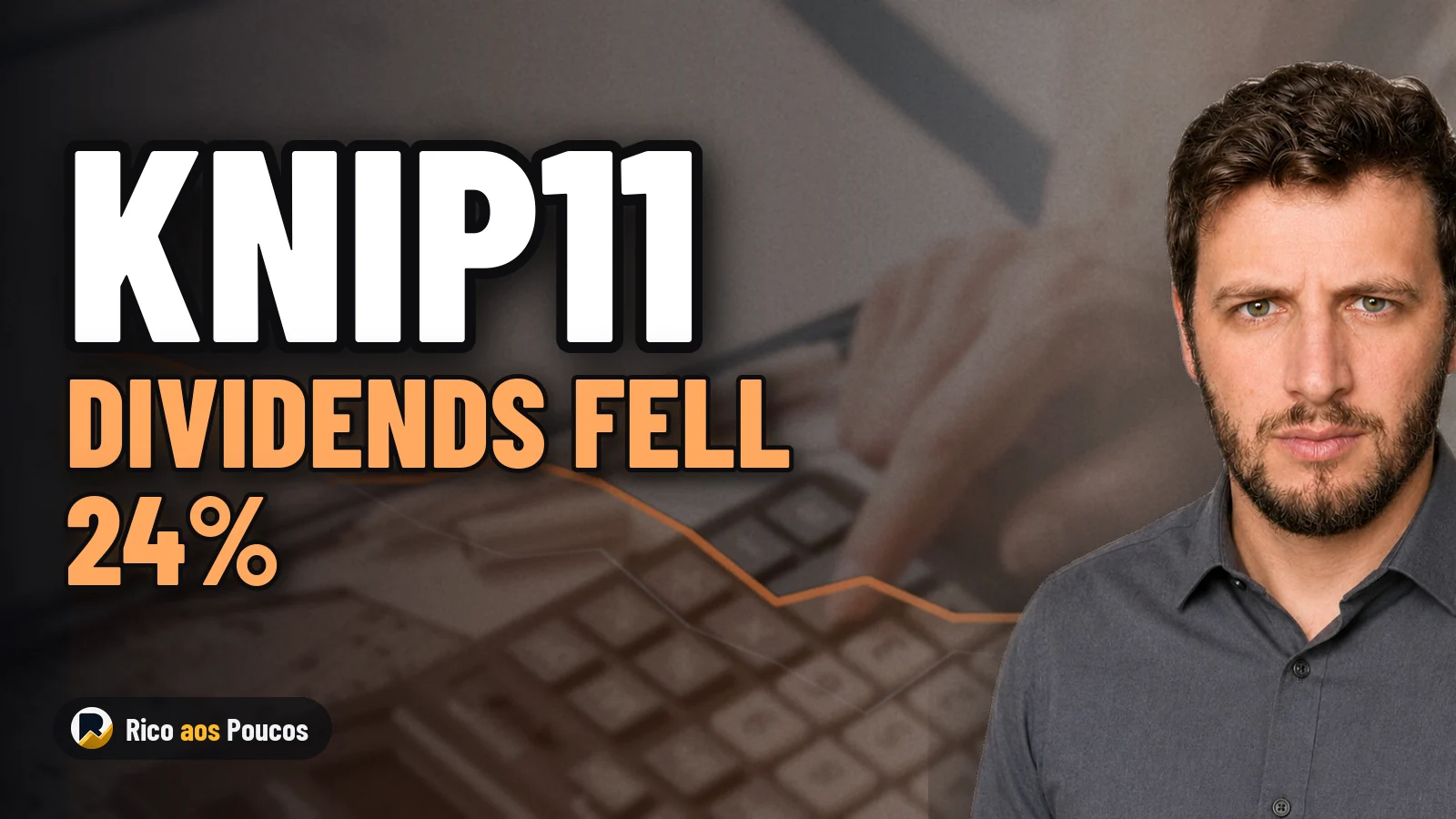


Why Dividends From The KNIP11 have they fallen?
The KNIP11 is a paper FII indexed to CDI and IPCA. When the Selic falls or inflation declines, the receivables that make up the portfolio generate less cash — and the fund distributes less. The fall of 24% in two months accompanies this macro movement, not a point problem of the background.
What is KNIP11 and who is Kinea
The KNIP11 is a Real Estate Investment Fund (FII) of the "paper" category — that is, it does not buy buildings, sheds or malls, but rather credit securities linked to the real estate sector. In practice, the money of the cotists is applied mainly in Certificates of Real Estate Receipts (CRIs), which function as loans granted to companies and projects in the sector. Whoever took the credit pays interest over time, and it is this flow of interest that fuels the monthly distribution of income.
The management is of the management. What is investing in investing?, one of the largest resource management houses in the country, linked to the ecosystem of Itaú. Kinea manages a family of FIIs real estate credits well known among passive income investors, and KNIP11 usually appears as a fund of real estate. alta liquidez — traded with relevant volume on the stock exchange — and with a broad listing base. Precisely because so many people follow the income month by month, any variation in the dividend gets attention quickly.
Why the dividends of a paper FII vary so much
Here is the central point: Paper background does not pay a fixed amount.. Unlike a brick FII, whose rents are contracted and readjusted once a year, the yield of a CRI fund depends directly on two macroeconomic indicators that move all the time — the ones that are rented and adjusted once a year. CDI (which closely follows the Selic rate) and the inflação (measured by indices such as IPCA and IGP-M).
The CRIs wallet usually pays in one of two formulas:
CDI + spread — the title yields the rate of CDI plus a fixed additional (e.g. "CDI + 2%"). When the Selic falls, the CDI falls together, and the post-fixed portion of the bottom delivers less.
IPCA + real interest — the title yields the inflation of the period plus a real rate (for example, "IPCA + 6%"). When measured inflation declines, the share indexed to IPCA also decreases.
As the KNIP11 portfolio mixes these two types of indexing, the monthly dividend is, in practice, a mirror of the macro environment of the period. Months of high Selic and pressured inflation tend to inflate the distribution; months of falling interest rates and weaker inflation pull the yield down. It is an expected mechanic — part of the product design, not a deviation.
What could be behind the fall of 24% 24% fall?
A variation of 24% in two months is expressive, but it finds a natural explanation in the behavior of the two indexers. Two macro movements, isolated or combined, help to understand the recoil:
When month-long inflation comes lower, CRIs coupled to IPCA deliver less correction in that cycle. And if the CDI is on a downward trajectory, post-fixed titles also deliver less. It is enough that the two indicators slow down at the same time for the distribution to fall sharply in a few months - even returning to the level below R$ 1.00 per share, as the fund presented.
An important point for correct reading: Minor dividend is not in itself a sign of portfolio deterioration.. In paper backgrounds, the fall may reflect only the macro cycle. What requires attention is to distinguish a mechanical reduction (indexers down) from a reduction per real problem, such as default of CRIs or provisions — situations that appear in managerial reports and reports, not just in the amount paid in the month.
Monthly income x annualized income
Another distinction that helps interpret the fall: the value in reals distributed in the month does not tell the full story. What matters when comparing funds is the one that matters. The dividend yield yields. — the annualized return on the price of the contribution, which is equal to the price of the contribution, A paper FII can pay less in reals in a month of weak indexers and still maintain a competitive yield if the quote price has also adjusted.
Therefore, the same movement of dividend fall tends to be read differently depending on what happened to the quote in the period. To follow only the absolute number of the payment — without looking at the price and the history — usually oversizes the perception of worsening.
What should the unitholder monitor from now on?
To keep track of the KNIP11 based on facts, and not on print of the month, some points concentrate relevant information:
1. The trajectory of Selic and CDI. As a good part of the portfolio is post-fixed, the direction of interest is the main thermometer of the future dividend. Falling interest tends to keep the distribution more contained; stable or upward interest tends to sustain it.
2. Current inflation (IPCA and IGP-M).). The portion indexed to inflation accompanies these indexes. Months of lower inflation reduce the correction passed on to CRIs.
3. The management reports and monthly reports. It is in them that appear the composition of the portfolio, the quality of credits, any delays or provisions and the average rate of CRIs. This is the material that separates a "cycle" drop from a "credit" drop.
4. The dividend yield, not just the value in reals. Compare annualized income over time avoids hasty conclusions from a single payment.
The fall of approximately 24% in the dividends of KNIP11 in two months, with a return to the level below R$ 1.00 per unit, is consistent with the nature of a paper FII indexed to CDI and IPCA. In a scenario of regression of these indicators, the distribution decreases mechanically. The most complete reading comes from following the interest cycle, inflation and fund reports—which show whether the variation reflects only the macro or something specific to the credit portfolio.
