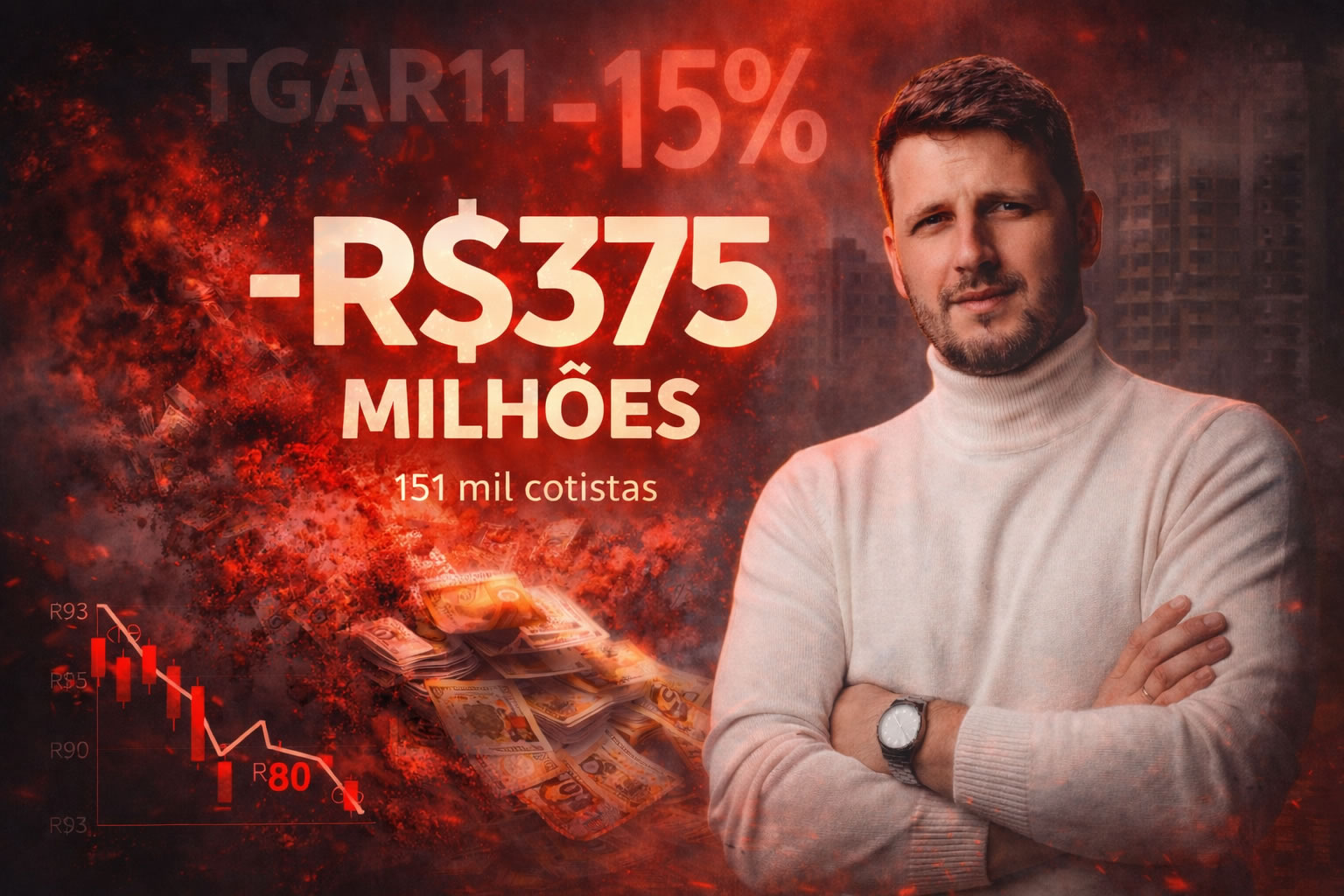
What happened?
TGAR11 fell from R$93 for R$80 in a few days after review of the guide. The bottom has R$2,5 billions of net worth. With the fall of 15% at the price of the unit, R$375 million evaporated from the market value of the fund (capitalisation).
Important: That doesn't mean the fund lost assets. It's just the drop in the price that investors are willing to pay for the share in the stock exchange. The real estate and receipts from the bottom are still there.
The Quick Context (For Who Is Outside)
On Monday (27/jan), TG Core Asset published the December management report with a bomb: dividend guidance revised down in the first semester of 2026.
| Metric | Before | Now. |
|---|---|---|
| Monthly Guide | R$0,90 - R$1,10 | R$0,70 - R$1,00 |
| Amplitude | R$0,20 (22%) | R$0,30 (43%) |
The market panicked. Volume deal exploded. The unit's melted.
Two days later, the fund manager Pedro Ernesto agreed to make a live live live to explain everything. It was almost 90 minutes of direct questions and answers. No filter, no marketing.
I watched the whole live. I took notes. And I'll give you the 10 points that really matter.
1. There is No Risk of Solvency (And This Is Fundamental)
The Background Is Not Broken
First question the fund manager answered: "Is there a risk that TGAR11 won't be able to finish the works?" Direct response: Oh, no.
The fund has:
- More than 70% of completed or practically completed works
- All the cash flow needed to finish the remnant is already addressed
- Leverage of less than 10% (conservative for the sector)
- All debts are of good quality (production financing with encouraged rates)
That was the most important information on live. The problem is timing, not ability.
2. The J Curve Turned — And This Was Expected
Real estate development funds follow a J curve: you invest money in the first years (negative phase), then start receiving (positive phase).
TGAR11 turned 9. But 90% of equity was invested in last 5 years. . That is, most of the portfolio is coming in the sixth year — precisely the moment of spooning.
? Good news: The Fund has taken over
In the second half of 2025, the TGAR reached the breakeven point of the J curve. It means that the need for new contributions is lower than the cash input of the projects already delivered. The worst is over.
The problem? The tide's turned just now.
3. Selic a 15% Locked Bank Transfer
That was the most technical — and most important — point of live.
When you buy an apartment at the plant, you pay like this:
- Input 5% for the Embedder
- 25% in plots during the work (direct with the developer)
- 70% via bank financing when the property is ready
That last step — when the bank pays the remaining 70% for the developer — is the Bank transfer. . That's when the development fund effectively Gets the money And you can distribute dividends.
The problem: with Selic to 15%, the cost of funding for the buyer exploded.
Translating: who needed income of R$15 thousand to finance a property in 2024, now needs to R$19 thousand to the same property. It's not everyone who's had 33% of wage increase in a year.
Result: A lot of buyers who could get funding before, now they can't.
Before Selic went up, a bank transfer took 3 to 6 months. . Today you're taking 9 to 12 months. . Some cases are over a year.
4. The Fund has R$2 Billions "Locked"
This is the number you need to record:
In other words: TGAR11 has Ready properties valued at ~R$550 million (only considering incorporations). When these real estate are sold and the banks pass on the money, there's approximately R$300 million net to distribute.
But that doesn't happen overnight. And that's exactly the problem.
5. The Sale of Viel (Cipasa) Delayed
The TGAR11 was negotiating the sale of its participation in Viel (Cipasa controller) for approximately R$300 million, with estimated profit of R$90 million.
That would give a capital gain of almost R$4 per unit.
The deal didn't close. Not for TGAR's sake, but for the buyer's sake.
That was one of the three pillars which justified the review of the guideline.
6. Why Did Guidance Get So Wide?
From R$0,20 amplitude to R$0,30. Why?
Manager's response: macroeconomic uncertainty.
Before, the guidance was quarterly. Now it's going to be biannual. E 2026 is the year of election, with Selic in 15%, credit stuck, and possibility of falling interest from March.
Translating: If Selic falls and the credit comes back, the background can go to the top band (R$1,00). If nothing changes, it is at the bottom (R$0,70).
7. Big Incorporaters Are Fine — But Selling Releases
A lot of people asked: "If the market is so difficult, why are listed developers doing well?"
Manager's surgical response:
.... Launch vs. Ready
Large Incorporaters Sell Mainly launches. . When you buy on the plant, all you need is Input 5% (R$50 thousand in a property of R$1 million). When the property is ready, you need 30% (R$300 thousand). It's a lot easier to sell launch.
TGAR11 is with real estate ready. . So it depends on the bank credit. Incorporaters sell pitches, so they depend a lot less.
Five years from now, when those releases are ready.If Selic is high, the developers will face the same problem that TGAR faces today.
8. Manager Will NOT Burn Value
Another recurring question: "Why don't you do an aggressive sales campaign and give it away?"
Answer:
He compared it with investing in real estate: nobody sells real estate with 60% discount Just because Selic's high. You expect the market to improve.
The same principle applies to TGAR11.
9. Strategies to Accelerate the Cashier
The fund manager's not sitting around. It listed three concrete initiatives:
- Bank correspondent: Team dedicated to speeding up funding approvals with banks
- Direct financing: For customers who have been paying for 3 years but cannot get bank credit, TGAR offers to finance directly (60 months)
- Increased exposure in CRI: With Selic a 15%, it makes more sense to lend money (CRI) than to develop real estate with slow return
These measures help, but They're not miraculous.. . Structural change depends on Selic falling.
10. The Great News: Monthly Webcast from March
Maybe the best news on live was this:
TGAR11 You will have Monthly Webcast
The fund manager has publicly committed itself to make a monthly webcast from March, commenting on the management report soon after the publication. This will dramatically increase transparency and reduce the fund's risk premium.
For a complex fund with 151,000 unit holders, that's fundamental.
What Does All This Mean to You?
After 1:30 a.m. live, three conclusions are clear:
1. The Problem Is Temporary
There is no structural risk. The assets are there. The money will come. The question is when, not if.
2. 2026 It Will Be Difficult
With Selic to 15% and elections, don't expect miracles. The first semester will be smaller dividends. Take it or leave.
3. 2027 Can Be Excellent
If the Selic falls (probable from March) and there is change of government (possible), the cycle can become strong in the second half of 2026 and in 2027. Whoever has patience can reap well.
My Reading (Personal Opinion)
A live confirmed my thesis of which I bought well the R$80.
The fund manager was transparent. It didn't. You didn't create unreal expectations. You made it clear that 2026 will be a year of crossing.
But it also made it clear that:
- The background it's not broken
- Assets have robust intrinsic value
- The timing will improve (question of when, no if)
I couldn't agree more.
My strategy continues:
- R$80: I set up the initial position (made)
- R$75: Increase position
- R$70: Stronger increase
♪ If you ♪ can't handle volatilityYou shouldn't be on TGAR11. ♪ If you ♪ understands long cycles, this can be an excellent point of entry.
