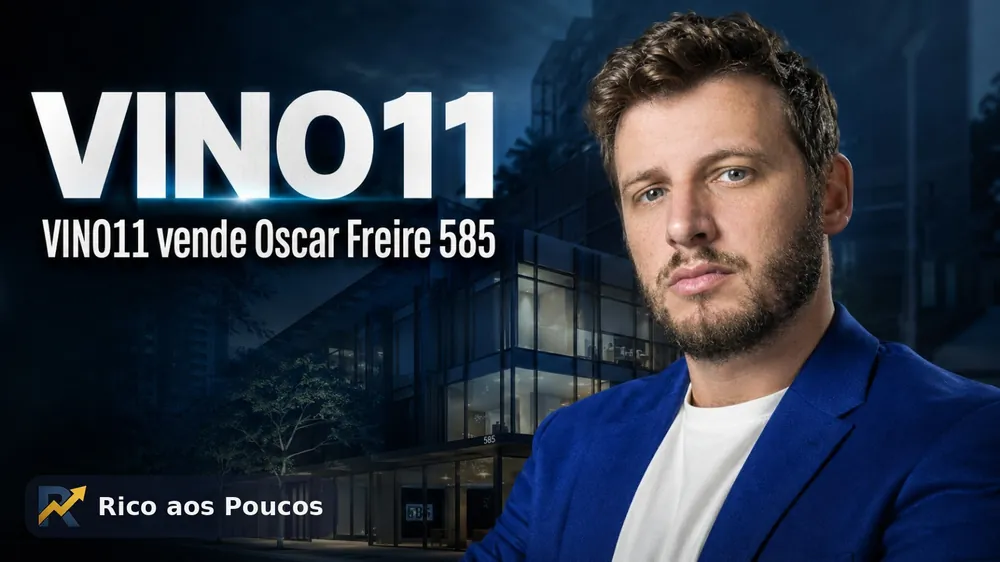
In 19/06/2026, the VINO11 — the Vinci Offices, fund of corporate slabs of Vinci Real Estate — published the Relevant Fact 1224501 announcing that it signed a promise contract of sale of the property Oscar Freire 585, in the Gardens, in São Paulo. For those who follow the fund, this is not just any sale: Oscar Freire 585 has been the most problematic asset in the portfolio for almost two years — vacant, costing and without relevant tenants. The direct question of the unit is whether this exit solves one problem or creates another.
The short answer: in the short term, it improves; in the long term, it depends on a number that the fund has not yet revealed. And there is one detail that many people confuse in the title — This is a promise of sale, not the finished sale.. . The difference completely changes the reading of the impact.
What is Oscar Freire 585 — and why did he weigh
Oscar Freire 585 is a standard office building with ZQX0ZX m2 Locable area (ABL) Oscar Freire Street, one of the most valued addresses in São Paulo. VINO11 holds 100% of corporate slabs, which is equivalent to 66,7% of the property (the rest are other fractions, such as the commercial ground floor). In the balance sheet, the fund's participation is marked around R$ 52,1 million — part of a total accounting value of R$ 78,2 million, or 6,6% of the fund's net worth.
Good address, good building — and yet a problem. The motive is the history. The main tenant was the WeWork, who went into default between June and August 2024. The fund moved eviction action (FR 729401), obtained injunction and WeWork took over. In February 2026 also the shop of Vitacon fell on the ground floor, generating an extraordinary expense of R$ 289 thousand. Today the property is with only 14% occupation, having as sole tenant relevant to ICTS, in typical contract.
Occupation of 14% in an entire building means, in practice, that the asset hardly generates revenue, but continues to consume IPTU and condominium — which in a vacant property are paid by the fund itself. In other words, Oscar Freire 585 was running like a cash leak. It was exactly the kind of asset that, in a portfolio of 9 properties, pulled consolidated occupation down (78%) and drained distributable results. That's why the news matters.
Promise of sale is not sale: what that means
One promise of sale It is a contract in which buyer and seller agree the intention and terms of the operation, but the business only takes place when determined. previous conditions They're fulfilled. Previous conditions are contractual requirements — documentation analysis, approvals, due diligence, any adjustments — which, if not met, may make the sale do not happen. . It's a marked marriage, not a consummate one.
While this period runs, the Relevant Fact brings a relevant point to the fund's cash: the potential buyer Pays R$ 250 thousand per month for rent, with a minimum guaranteed of 12 tranches — that is, at least R$ 3 million at the minimum total. In practice, the asset that was a cash hole starts generating resource input even before any sale closes. The estimated impact is about +R$ 0,003 per unit per month the result.
What changes — separating the short from the long term
It's worth dividing the effect into two layers, because they have different magnitudes and probabilities.
Short term (it's already on). Deficiency rental of R$ 250 thousand/month enters for at least 12 months while the previous conditions are resolved. It's the right recipe, hired, that pulls the asset out of operational red. Small in R$/unit, but positive and immediate.
Long term (if the sale takes place). Then the game changes its size. With the sale closed, it enters the back box something around R$ 52 million — estimate based on the book value multiplied by the participation of 66,7%, since the real price has not been disclosed. With this box, management has relevant options of capital structure. The most obvious is partially amortize CRI Haddock (R$ 67 million to IPCA+5,575% until Oct/2035). Reducing this debt would cut the monthly financial expense into something like R$ 300 thousand to R$ 400 thousand, equivalent to about R$ 0,003 to R$ 0,005 per unit per month of additional result — this, yes, is a recurring effect and more material than the shortage rent.
To scale: background loads R$ 422,5 million in leverage, in two IPCA-indexed CRIs (the one from R$ 355 million from the Globe Headquarters to IPCA+ZQ1ZQX to Jan/2037 and the one from the Haddock R$ 67 million). In high inflation cycles, this load bites directly at the distributable. Swap a vacant asset to 14% for cash that slaughters debt from IPCA+5,575% is conceptually a recycling that makes sense — as long as the price is reasonable.
There is the opposite risk, which needs to be in the account: if previous conditions are not met, the sale does not happen and the asset returns to the current state — vague to 14%, draining box. Deficiency rent softens this scenario for up to 12 months, but does not eliminate it.
Why the undisclosed price is the central point
Here's the analysis node. The Important Fact did not bring the selling price, and it is precisely the price that defines whether the operation is good, neutral or bad for equity. The concept to understand is that of equity value per unit (VP/unit), today in R$ 9,81: it reflects how much the assets of the fund are worth in the balance sheet. If a property is sold above of the accounting value, the PV/unit tends to rise; if it is sold below, the fund realizes a loss and the VP/unit falls.
The accounting value of Oscar Freire 585 is R$ 78,2 million. But there's a sign of caution: Colliers report of December 2025 has already marked the asset with devaluation of -6%, equivalent to -R$ 5,4 million in the entire property. Add to this two factors that push the price down — the property is the 14% of occupation (buyer assumes the risk of reoccupying) and the Gardens are a region that, on the margin, values more for residential and retail use of luxury than for corporate slab. All this points to real uncertainty as to whether the final price will be in the account, above or below.
Impact on portfolio and vacancy
If the sale is carried out, the portfolio of VINO11 falls from 9 for 8 properties. . And it changes the map of vacancy. In ours reanalysis of 10/06/2026, we showed that the fund had reduced from 4 to 3 the assets with relevant vacancy after the normalization of BBS Brooklyn. With Oscar Freire gone, there'd only be one left. two: the Haddock Lobo 347 (26% occupied, with three contracts in advanced negotiation) and Vita Corá (75%, variable contract with Regus/IWG).
The rest of the portfolio is the anchor of the thesis: a Headquarters Globo SP, with 39 thousand m2, 100% occupied by Globo in atypical contract that accounts for about 60% of revenue and has WAULT (the remaining average length of contracts) of 7,2 years. Taking an occupation ZQX0ZX asset from the mix tends to raise the consolidated occupation — the current 78% for something close to 82-83%, depending on the remaining portfolio. In terms of operational profile, the bottom gets cleaner.
| Size | Today (9 properties) | If the sale closes (8 properties) |
|---|---|---|
| Portfolio real estate | 9 | 8 |
| Relevant vacancy assets | 3 | 2 |
| Consolidated occupation | 78% | ~82-83% |
| Oscar Freire 585 in the result | cost (wage) | box ~R$ 52 Mi |
| Asset revenue (internal) | ~zero | R$ 250 thousand/month |
Verdict
Positive movement in the margin — does not materially change the recommendation of MANTER. The promise to sell reverses the sign of the worst asset in the portfolio: to drain cash to generate R$ 250 one thousand/month deficiency rental (~R$ 0,003/unit/month), with the potential to improve the capital structure if the sale closes and the cashier is used to shoot down the CRI Haddock.
But three uncertainties hold the enthusiasm: (1) It is a promise, not a sale — the preceding conditions may not be met; (2) the price was not disclosed, and with the asset to 14% of occupation and report Colliers already in -6%, there is real risk of loss over the accounting; (3) there is no public information about the fate of the cashier — whether to take down debt, reinvest or distribute. The effect of R$ 0,003/unit is good, but small. What would actually move the thesis is the use of the cashier, and that is not yet clear.
The R$ 4,76, with 0,49 P/VP (discount of 51% on the VP of R$ 9,81) and 12,77% DY, the VINO11 follows as a broad asset discount case in which the operator is slowly improving — Standard BBS, Oscar Freire on the way out, retreating vacancy. MANTER It remains the reading for those who already carry it.
For who it is — and for whom it is not
It makes sense to who already has a position and sees in the progressive cleaning of the portfolio (output of vacant assets, recomposition of occupation) a trigger of re-enactment in the medium term, tolerating the concentration of 60% of revenue in the headquarters of Globo and leverage in IPCA+. 12,77%'s DY remunerates the wait.
It doesn't make sense to who needs predictability in the short term: the sale depends on previous conditions, the price is unknown and the recurring impact only materializes if the operation closes and the cash is well allocated. Those who do not tolerate dependence on a single tenant (Globo) or low liquidity should also look with reservation.
