. Errata and correction (08/05/2026)
The original version of this article, published in 07/05/2026, attributed 58,3% of the assets of the CACR11 to "Kahhu Incorporater — Sian Constructor and Incorporater Ltda (CNPJ 54.680.938/0001-29), registered in 10/04/2024" as debtor of the three Bahian CRIs. One reader pointed out in the comments that this framework was wrong, and the independent verification confirmed:
- The legal debtor of each CRI is the project-specific SPE — not Kahhu, not CNPJ Sian Ltd;
- O original formal developer was another entity in at least two of the three cases: NPAR (28 years of activity, historical partnership with SQL+ Architects / Sidney Quintela) in Reserve Guaiú/Santo André; Incorporated Vertis (second institutional material of the project published in Dec/2025) Amalfi Itaparica Resort Residences;
- O Sian/Kahhu Real Estate Group entered jail in Jul/2025 — first as a builder and then as a new development brand — after which Cartesia itself describes it as "the 20-month process of change of incorporated company";
- We do not publicly locate the identity of final controller of each debtor SPE. There are claims in unit forums that final beneficiaries would include little-known individuals (names mentioned: Samir Mohamed and Thales Pens) — We couldn't verify. these allegations in independent public sources; they are recorded as pending transparency, not as fact.
The central thesis of the analysis — SALE for conservative profiles and limited speculative trade for bold — does not change. The reasons why she's SALE, yes. Details along the text. We appreciate the public correction.
The fall in one sentence: the engine stopped
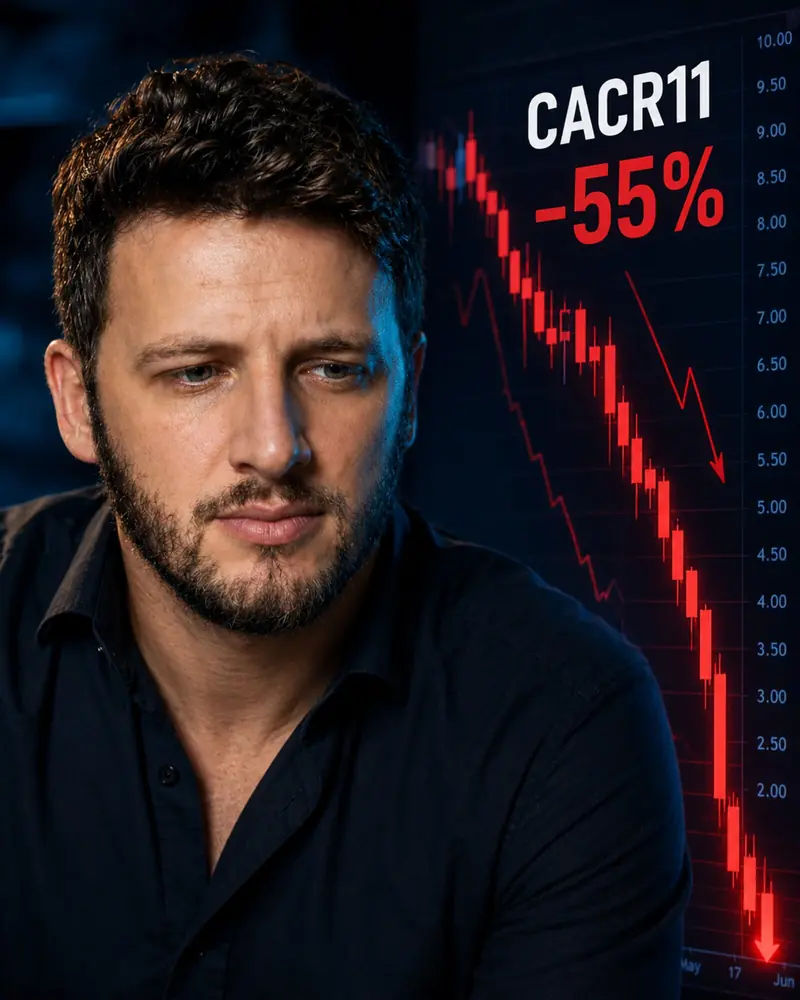
Prior to the announcement, CACR11 was one of the most commented paper FIIs on the market: 19,2% dividend Yield, 0,86 P/VP, base of 26,000 unit holders. In 03/05/2026 (Sunday), BRL Trust and Cartesia reported the full retention of the R$ 1,24/unit established in April. In the first post (04/05) the unit fell 42,4% and closed the R$ 47,01. In the second, plus 11,5% — R$ 41,60. On 07/05, R$ 34,50. In five studs, loss of 57,6%. . P/VP retreated from 0,86 to 0,36.
Current photo: May/2026
The question everyone is asking — and why it is poorly formulated
When a FII collapses 57% into five posts after the fund manager zeros the dividend, every investor asks the same question: Is it an opportunity or a value trap?
The problem is that this question, the way it is formulated, leads to a useless answer. The correct answer depends on what scenario is materialized in the next 4 to 12 months. And this scenario does not depend on the fund manager (Cartesia), the administrator (BRL Trust), or the market. Depends on three Bahian SPEs — Reserva Guaiú/Santo André, Amalfi Itaparica and Savoie — where the original formal developer has already been replaced once (in Jul/2025) and whose final corporate structure has not been disclosed to the market by the Fund. This one. is the blind spot that the previous version of this article simplified.
Before answering the right question, it is important to understand why the old question fails.
The reason for the crash was not the zero dividend — it was the engine that stopped
The explanation that circulates in forums and podcasts is that the unit collapsed because the fund manager "decided" to suspend dividends. This reading is incomplete. What happened was deeper:
- The formal net cash at sea/2026 was R$ 2,82 Mi — according to item 9 of the Structured Monthly Report. Composed of R$ 100 in availability and R$ 2,8 Mi in fixed income funds. To distribute a single monthly historical payment (R$ 1,20 × ZQX1ZX Mi units = R$ 5,8 Mi), it would be necessary double the cash that the bottom had.
- The CACR11 model was rotating. The Management Report itself states, with explicit words: "It is common practice that the fund undertakes acquisitions of new CRIs in order to bear the payment of the financial obligations of the already issued CRIs". . Translation: New capital (via P/VP issues close to 1) financed the debt service of the old CRIs while the real estate was in business. When the unit dropped below R$ 60 and the 7th Emission was cancelled on Sep/2025, this engine stopped.
- Without new capital entering, the interest reserves embedded in each CRI are consumed. Each CRI has a works fund + interest fund that pays the monthly IPCA regardless of the developer. This fund lasts for X months. Without replacement via new emissions and with late releases, the stock of these reserves runs out.
- The 7th Emission was the only bridge out — and it was cancelled in the speculative pressure of set/2025, amid the re-enactment of -18,2% by Daycoval. Without it, the regulatory reframement (debtor exposure limit, CVM term up to Dec/2026) became a problem without solution in sight.
In short: the fund manager did not "decided" suspend dividends. Him. was forced by arithmetic. . With R$ 2,82 Mi in box and no new source of capital, even distribute R$ 0,40/unit would have zeroed the box in 30 days and closed any bargaining space with the chain holding the PL 58%. Zerar was the only move left — and it is also a message to the Bahian SPE controllers: "you have to launch now, or the guarantees begin to be executed."
The point the previous version missed: the structure behind the 58%
58,3% equity is a three-layer chain, not a single company
The three Bahian CRIs (Santo André/Reserva Guaiú 25,1%, Amalfi/Itaparica 21,3% and Savoie 11,9%) add up R$ 287 million outstanding debtor. . But the reading "all this is from Kahhu Ltda" — which appeared in the first version of this article — is wrong. The chain has three layers:
- Legal debtor of each CRI = project-specific SPE. . It is the SPE that has signed the issue contract and is responsible for the payment. Each has its own CNPJ which, in the public reports of the fund, does not appear with full transparency on the final controller;
- Formal Incorporater = entity that registered the memorial of incorporation in the registry. . For the Guaiú Reserve, in Santa Cruz Cabrália/BA, public materials of the office SQ+ Architects (Sidney Quintela) describe the work as "a realization of the NPAR, incorporated with 28 years of market". For the Amalfi Itaparica Resort Residences, the announcement published by Revista Yacht in Dec/2025 states textually: "First release of Vertis Incorporated by Kahhu Real Estate". . For the Savoie in Salvador, the original formal developer was not publicly disclosed in the materials we were able to access;
- Builder + new development brand = Sian Group / Kahhu Real Estate. . The Sian Group (45+ years old, ex-Andrade Mendonça) entered the chain in Jul/2025, after the original developer retreated — a process that Cartesia herself describes in management reports as a 20-month "incorporation change". Sian has track record in heavy construction (Salvador Shopping, Orthopedic Hospital, Salvador Convention Center, Bresco Bahia logistics, Integrated Public Safety Center). The brand Kahhu Real Estate it was launched in 2026 as a residential arm of this new phase — without track record itself in luxury incorporation.
Why does it matter instead of being technical?
One: If a release is delayed and the CRI defaults, the creditor (CACR11/Cartesia) will execute what is fiduciaryly alienated — the land and receipts of the SPE. But a SPE is what has net worth — not Sian Constructora. The personal endorsement and divestment of SPE shares only take the final controller of SPE, and this controller is not disclosed in the monthly reports of the fund. . The unitholder can't audit from the outside.
Second: the replacement of the embedder in the middle of the project is itself a sign of stress. Incorporation does not retreat from work with VGV of R$ 1 billion without something having broken — it is capital, it is demand, it is corporate conflict. Cartesia calls the process "product repositioning" that raised the added VGV of the three Bahians from R$ 476 million to R$ 1 billion. That could have been it. But it is. Also It is true that during these 20 months of transition the works stopped moving forward, the sales did not unlock and the fund cash flow bled.
Third: Switching embezzlers is like changing captains in the middle of the ocean. Even if the new captain (Sian) has 45 years of experience on another route, he needs to learn the passenger, crew and current cargo — because incorporation luxury is not shopping construction. Sian has a resume in heavy work and public work; Kahhu Real Estate has 2 years as brand and no release delivered. This pivot is where the real risk is — not in the "Youth of CNPJ".
On the transparency of the ESS — the outstanding point
In unit forums there are allegations that the final controller of one or more Bahian SPEs would be a little-known financial market person (with names cited as Samir Mohamed and, at a later time, Thales Pens). These claims could not be verified from independent public sources — neither as a fact nor as a disproved fact. What is factual and relevant is that the corporate structure behind each debtor SPE is not clearly presented in the monthly reports from the bottom, and this opacity — regardless of who the final controller is — is a symptom to be precarious. In high-yield paper FII with PL 58% in this chain, this transparency should be default, not the exception.
Where the real risk lives — and why it is different from HCTR11
The parallel with the HCTR11 that circulates in the market is understandable, but leads to error. In HCTR11, the problem was quality of CRIs: some simply did not have adequate real guarantee, or had guarantees tied to fragile SPEs without recourse to the corporate property. The defaults came because the contracts were weak.
In CACR11 the situation is different. All 10 CRIs are "on-the-go" status according to the most recent Management Report. No default declared. The guarantees are robust: fiduciary disposal of the funded properties + sale of receipts of sales + shares of the ESS in collateral + personal endorsement of controllers + fall clause among the three Bahians (if one fails, others' guarantees respond). Average warranty ratio: 225%.
The risk of CACR11 is not the legal quality of the contract. Yeah. functional insolvency + real contract opacity — who is on the other side of the table when they need to negotiate:
| Step | What needs to happen | Current status |
|---|---|---|
| 1. Urban modifications | Leave in Bahia City Halls (Itaparica, Salvador, Santa Cruz Cabrália) | Delayed — forecast Apr/26 → slipped |
| 2. Commercial launch | SPE of each Bahian project start binding sales (Reserva Guaiú, Amalfi, Savoie) | 2Q2026 (after 10/25) |
| 3. Sales speed | Conversion of 110+ Amalfi reserves into firm contracts + new pickup | Non-binding reserves may fall |
| 4. Get used to Station VM | Injunction TJ-SP fall, Habite exit, transfer bank | Suspended for injunction — no term |
| 5. Reserves of CRIs | Hang on until 1-3 up. | Being consumed — window 6-18 months |
| 6. Regulatory compliance | Reframing plan exposure by debtor (SPE/group limit) | CVM deadline 10/2026 — may not comply |
| 7. Corporate transparency | Clear disclosure of the final controllers of the Baiana SPEs | Not published in monthly reports |
What can go wrong It's not a spectacular bankruptcy with contracts turning to dust. It is the Sian/Kahhu chain not being able to launch in time, the reserves of the CRIs run out, the fund need to execute fiduciary disposal of the buildings and shares of the ESS — and this execution take 24-36 months to monetize, against a final controller whose ability to provide additional capital the unit cannot measure. During this period, the unitholder gets stuck with capital, without monthly income and without liquidity. It is not absolute destruction — it is capital imprisoned in judicial recovery.
This is the risk that the market is pricing in 0,36 P/VP. It's not "goes to zero." It's three years without income or liquidity.
The Direct Answer — CACR11 Is It Opportunity?
I'm gonna take a position instead of throwing it both ways.
The honest answer in 4 conditions
CACR11 to R$ 34 It's an opportunity. if, and only if, the four conditions below materialize:
- Amalfi's modifier leaves in up to 60 days in the city of Itaparica (and 114 reserves became firm contracts in up to 90 days).
- Saint Andrew and Savoie begin effective pre-release until Jul/2026 — not "place branding", but binding sales.
- Injunction of TJ-SP that locks the Habite Station Villa Madalena fall in up to 90 days.
- BRL Trust + Cartesia manage to unlock a 7th/8th unit emission in 2T-3T/2026, even with high agio, to refuel the rotary engine.
If that happens, the unit should go back to the track R$ 50-65 in 6-12 months, with gradual resumption of DPS around R$ 0,60-ZQ1ZX/unit. Potential return of 50-90% on capital + dividend. That's the base scenario of the buyer today.
♪ And it's a trap if ♪
- The Bahian modifications continue to delay quarter after quarter.
- The DF auditor of 2026 also issued abstention — definitely destroying confidence in the VP.
- To emerge any corporate event in the Bahian SPE chain or in the Sian/Kahhu Group (fiscal problem, mass distraction, corporate conflict, new corporate change) that becomes public knowledge.
- They are unable to reissue and the regulatory reframement will win by ten/2026 without compliance.
In this scenario, the unit may fall into the band R$ 20-25, the DPS takes 18-30 months to come back and yet at lower level (R$ 0,30-ZQ1ZQX). Investor gets stuck in locked-up capital.
Honest Probabilities — Where Both Theses Balance
| Scene | Probability | Quota in 12m | Average DPS 2S26 |
|---|---|---|---|
| Optimist — 4 conditions fulfilled | 25% | R$ 55-70 | R$ 0,80-1,10 |
| Base — 2 of the 4 conditions fulfilled | 45% | R$ 38-50 | R$ 0,40-0,70 |
| Pessimistic — delays persist | 25% | R$ 22-30 | R$ 0,15-0,40 |
| Catastrophic — Sian/SPE chain event + auditor 2026 | 5% | R$ 12-18 | R$ 0,00 (suspended) |
Calculating the mathematical expectation on the current R$ 34,50 unit:
- 25% × R$ 62,5 = R$ 15,6
- 45% × R$ 44,0 = R$ 19,8
- 25% × R$ 26,0 = R$ 6,5
- 5% × R$ 15,0 = R$ 0,8
- Expected unit in 12 months: R$ 42,7 (expected capital gain: ~24%)
Add expected average DPS around R$ 0,40/unit in the next 12 months (R$ 4,80/year) and the expected total return is in ~38% in 12 months. . It is a significant return, but it comes with brutal volatility: the standard deviation between scenarios is very high, so it is possible to materialize loss of 40% before any recovery.
For whom CACR11 makes sense — and for whom not
| Profile | CACR11 to R$ 34? | Why? |
|---|---|---|
| Who depends on stable monthly income | Do not buy / leave | DPS can stay zero for 6-12 months in the base scenario. It's not a rental vehicle. |
| Conservative Investor (Brick FIIs, CDI paper) | Do not buy | Volatility incompatible with profile. IPCA+ long paid 7-8% real with sovereign risk. |
| Who already had a big position in the IPO/anterior | Reduce, do not zero | Performing partial loss releases capital for better allocations; maintaining residue allows upside capture. |
| Experienced investor, separate opportunity box | Small purchase (1-2% from wallet) | Positive asymmetrical risk-return, but with high volatility. Limited position. |
| Speculator that tolerates total loss | Tactical Purchase | Who understands the binary thesis and accepts 30-40% additional fall as ticket cost. |
What to monitor in the next 90 days
If you have decided to keep or buy, there are 5 marks that need to be checked frequently:
- Amalfi/Itaparica Modifier — registration in the Itaparica office. Without it, real launch doesn't happen. Track monthly management reports.
- Conversion of 114 reserves into firm contracts In Amalfi. Non-binding reserves may fall.
- Get used to the Villa Madalena Station — TJ-SP injunction. Get used to exit release bank transfer and amortization of the CRI (3,6% of the PL, but it is symbol).
- Re-issue capture — Cartesia + BRL Trust need to unlock 7th/8th issue. If they do not capture in 2T-3T/26, the probability of the pessimistic scenario rises.
- Auditor of the half-yearly DF 2026 — RSM reissues clean opinion or abstention defines confidence in the VP.
Each of these marks moves probability between scenarios. Keeping up is not optional for those who invest in this fund.
? Analytical Verdict
CACR11 is a asymmetrical positive risk-return speculative tradeNot a monthly income investment. The R$ 34, discount of 64% on the VP adequately pricing the visible risks (suspension of DPS, delays, abstention of the auditor), but underestimates two structural risks: (i) the replacement of the Embedder in the midst of the three Bahian projects with limited transparency over who is the final controller of the debtor SPEs, and (ii) the rotating model of financing broken by the fall of the unit. The key question is not whether the fund "goes to zero" – is whether it will deliver 38% in 12 months or stay 24-36 months with capital stuck in execution of collateral against counterparty whose ability to absorb financial pressure the unit holder cannot verify.
For conservative profiles and investors relying on monthly income, the recommendation is to sell. . For experienced investors with long horizons and volatility tolerance, limited position (1-2% portfolio) with separate opportunity box makes sense — and requires active monitoring of the 5 critical milestones. Those who keep it by inertia are betting without reading the thesis.
Where to dig
- Full analysis of the CACR11 (all indicators, graphs, simulations and institutional dossier V3)
- TRBL11 — cutting DPS in paper FII with similar lessons
- ABCP11 — When the unit holder finds out what he was buying
- See all FIIs analyzed
