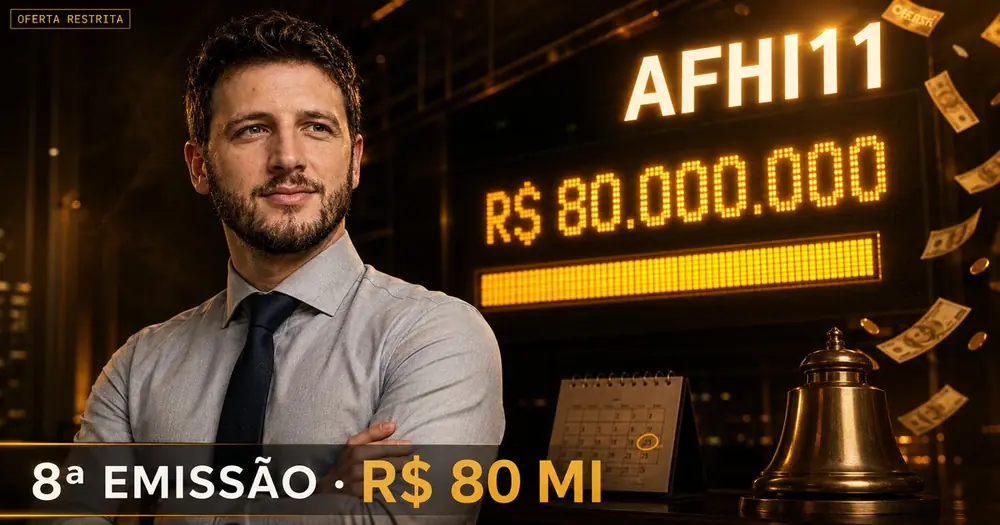
What changed on the night of May 13
BTG Actual Financial Services (administrator) and AF Invest Real Estate (fund manager) released a Relevant Fact (ID Fundos.NET 1190150) approving the 8th issue of AFHI11 units. In a few pages of the CVM, three important decisions for the unit holder: (1) the fund will capture up to R$ 100 million (R$ 80 Mi base + 25% additional batch); (2) the target audience of the primary offer is only Professional Investor; (3) the common unit only avoids relative dilution exercising the right of preference, with factor 0,17511. The schedule is short: base date 18/05, DP exercise of 20/05 to 01/06/2026, leftovers up to 12/06, final settlement on 18/06.
The raw numbers of the 8th issue
The detail that changes everything: the offer is "restricted"
The text of the Relevant Fact defines, in item (ii), the target audience: "investors that meet the characteristics of a professional investor, as defined in Article 11 of the Resolution of CVM No. 30, of May 11, 2021". . In direct Portuguese: to participate freely in the primary offer, the investor needs to have more than R$ 10 million in financial applications and attest this condition in a form proper to the distributor.
This means that the small investor person — who makes up most of the current 38.529 unit holders of the AFHI11 — cannot enter the 8th issue freely. . The only entrance door is the right of preference: who was already a unit holder on the third working day after the start announcement (date-base 18/05/2026) has guaranteed the right to subscribe in proportion to the factor 0,17511, without having to prove professional status. Above that — nothing, or transfer of the right to qualified third parties.
This design is legally permitted by the rite of auto log of the CVM 160 (Art. 26 item VII). It is the same structure used by other large funds in rapid emissions — recent case: the 7th issue of PMLL11, announced the day before. It's not irregular. But it's a choice that tightens retail in a short time.
The ratio factor 0,17511 — practical reading
Each unit currently held gives the right to subscribe, in the Exercise Period of the Law of Preferences, exactly 0,17511270173 new units. . Since there is no fraction — rounding is always down — the unit holder needs at least 6 current units to be able to subscribe to 1 new (6 × 0,17511 = 1,05, round to 1). And in the full exercise, every 100 current units generate a right to only 17 new units.
| Your current position in AFHI11 | New units you can subscribe to the DP | Cost of the financial year (R$ 95,48/unit) | Final position (if exercised 100%) |
|---|---|---|---|
| 10 units (~R$ 955) | 1 unit (10 × 0,17511 = 1,75 → 1) | R$ 95,48 | 11 units |
| 50 units (~R$ 4.774) | 8 units (50 × 0,17511 = 8,75 → 8) | R$ 763,84 | 58 units |
| 100 units (~R$ 9.548) | 17 units (100 × 0,17511 = 17,51 → 17) | R$ 1.623,16 | 117 units |
| 500 units (~R$ 47.740) | 87 units (500 × 0,17511 = 87,5 → 87) | R$ 8.306,76 | 587 units |
| 1.000 units (~R$ 95.480) | 175 units (1.000 × 0,17511 = 175,1 → 175) | R$ 16.709,00 | 1.175 units |
The exercise of the right of preference requires an additional contribution of approximately 17,5% on the capital already invested In the background. Who doesn't have cash flow can surrender the right via bookkeeper (to another unit holder or a qualified Professional Investor) and capture part of the value. Who chooses to do not exercise and do not give in undergoes relative dilution:
| Post-emission scenario | Quotas in circulation | Difference | Relative participation of those who did not subscribe |
|---|---|---|---|
| Today | 4.789.190 | — | 100% (base) |
| Partial distribution (minimum R$ 1,00 Mi) | ~4.799.706 | +0,22% | ~99,8% |
| Base integral emission (new 838.648) | 5.627.838 | +17,5% | 85,1% |
| Full issue + additional batch 25% | 5.837.500 | +21,9% | 82,0% |
In the maximum scenario (full issue + additional lot), who does not subscribe and does not give in comes to hold 82% of the relative participation it had. It is not a loss of direct capital — the issue price is the VP itself, so the unit does not devalue by the transaction. But it's loss of relative weight in future income: the same R$ 0,98/monthly unit, distributed on a higher 22% base, depends on the fund manager being able to allocate the R$ 100 million in CRIs that deliver at least the same profitability of the current portfolio.
The essential difference: the price here is "honest"
Here AFHI11 separates from most restricted emissions: the price of R$ 95,48 corresponds exactly to Share value in 30/04/2026, no agiorization, no discount, no primary distribution rate. The unit holder exercising the right of preference paid by the VP — not by the excess unit.
Secondly, the fund manager maintains the tradition that differentiates AFHI11 between paper FIIs: The distribution costs are paid in full by AF Invest Real EstateNot by the unitholder or the bottom. In all seven previous emissions it was like this. It's a real differential against pairs like CPTS11, RBRR11 or KNSC11, which charge performance fees and/or distribute costs via fund.
Third, Complement I brings Nominal indicative pipeline — something rare in restricted offers. 12 specific operations with sector, risk, volume and rate are listed:
| Active | Sector | Risk | Volume | Indicative rate |
|---|---|---|---|---|
| CRI Incorporation | Incorporation | High Grid | R$ 22,0 Mi | CDI + 2,00% |
| CRI Home Equity | Home Equity | High Grid | R$ 25,0 Mi | CDI + 2,00% |
| Logic CRI | Logistics | High Grid | R$ 15,0 Mi | IPCA + 9,90% |
| CRI Agribusiness | Agribusiness | High Grid | R$ 6,0 Mi | IPCA + 9,50% |
| CRI Incorporation | Incorporation | High Yield | R$ 8,0 Mi | CDI + 5,00% |
| CRI Hospital | Hospital | High Grid | R$ 5,0 Mi | IPCA + 10,00% |
| CRI Core Retail | Essential Retail | High Grid | R$ 5,0 Mi | IPCA + 10,00% |
| CRI Incorporation | Incorporation | High Grid | R$ 7,0 Mi | IPCA + 9,20% |
| CRI Home Equity | Home Equity | High Yield | R$ 5,0 Mi | IPCA + 10,50% |
| CRI Shopping Center | Shopping | High Yield | R$ 6,0 Mi | IPCA + 9,90% |
| CRI Allotment | Allocation | High Yield | R$ 6,0 Mi | IPCA + 11,00% |
| CRI Shopping Center | Shopping | High Yield | R$ 10,0 Mi | IPCA + 9,60% |
| Medium Mix (54,17% IPCA / 45,83% CDI) | R$ 120,0 Mi | CDI+2,44% / IPCA+9,90% | ||
The pipeline of R$ 120 million is 20% larger than the emission ceiling (R$ 100 Mi with additional batch), which gives selection clearance to the fund manager. Approximately 71% of the pointed operations are High Grade and 29% High Yield — proportion compatible with the current portfolio (69%/31%). The average IPCA+9,90% and CDI+2,44% rates are above the current average portfolio rates (IPCA+8,62% and CDI+2,86%), which gives technical reason to expect the allocation of new resources to sustain — or elevate — the DPS.
Why reissue five months after the 7th?
The 7th broadcast, closed in 10/2025, caught only R$ 21,98 million R$ 80 mi target (22% of the enlarged target). The subscription was sufficient to dilute the R$ 1,01 DPS to R$ 0,97 from Jan/2026 — but insufficient for the fund manager's growth plans. Five months later, the 8th, now restricted to Professional Investors and with nominal pipeline already mapped.
The reading is direct: the fund manager changed target audience precisely to avoid the problem of the 7th. Offers for professional investors (above ZQX0ZX mi in applications) usually have concentrated tickets and running speed: a family office or institutional treasury decides in 48-72h, while a retail offer needs slower booking. The nominal pipeline increases predictability — professional investor likes to know exactly where CRIs comes in.
For the average person, however, this means: less influence on the emission and absolute dependence of the right of preference to maintain relative position. There is no retail period, there is no batch for qualified retail. It's PD or dilution.
The contrast with the 7th: management learned, but concentrated power
The 7th issue of Dec/2025 was restricted to current unit holders — not to Professional Investors. Result: captured only 22% from the target, with retraction of 53 units per unit holders that conditioned subscription to the integral capture. Warm demand. The 8th issue (May/2026) opens the target audience to any Professional Investors, including institutions that were not yet unit holders. It is the opposite strategy: instead of relying on the current basis, it seeks qualified new capital. For the fund manager, it's more efficient. For the common unit is less relevant — only the right of preference separates those who stay from those who dilute.
The Schedule — Critical Dates Up to June 18
| Marco | Date | What's happening? |
|---|---|---|
| CVM Registration + Home Ad | 13/05/2026 | Approval published. Formal start of the Offer deadline. |
| Basic date of the Preference Right | 18/05/2026 | Closing position defines who is entitled to PD. Who to buy AFHI11 after no Gets PD. |
| Start of the year of DP (B3 and bookcase) | 20/05/2026 | Cotista decides to exercise (total/partial), surrender the right or ignore. |
| Closure DP — B3 | 01/06/2026 | 9 working days after the start date. Final deadline for the home broker. |
| Closure DP — bookkeeper | 02/06/2026 | 10 business days. Disposal of the PD. |
| Leftover subscription period | 05/06 to 12/06 | Those who have exercised the DP may apply for additional units (sobras + additional amount). |
| Settlement of leftovers | 18/06/2026 | Remaining units go to Professional Investors via Leader Coordinator. |
| Maximum closing date of the Offer | 09/11/2026 | Regulatory deadline (180 days). Before that, if distributed in full, the offer closes. |
For the average person, the critical window is from 20/05 to 01/06/2026 — only 9 working days to make the decision and formalize it with the home broker. Whoever loses the deadline on B3 can still operate via bookcase (BTG) until 02/06, but the path is more bureaucratic.
The frame for different profiles of unit
| Profile | Practical Recommendation | Why? |
|---|---|---|
| Long-term unit who trusts AF Invest thesis | Exercise DP 100% + ask for leftovers | Pay R$ 95,48 in a unit whose VP is R$ 95,48 is to enter the VP, without agio, with zero emission costs. The indicative pipeline points to rates above the current portfolio — allocation should be positive for the DPS. |
| Cotista who prefers to preserve box | Cease DP via bookcase | The Preference Right has market value — it can be transferred to another unit holder or to a Professional Investor, recovering part of the value without mobilizing cash. |
| Small unit (5-20 units) not available | Accept partial dilution | In a small position, the exercise can generate 1-3 new units — high operational effort for small financial impact. Maximum relative dilution of ~18% on current participation. |
| Who was considering entering AFHI11 now | Wait for settlement to settle | The emission period typically brings pressure in the secondary (selling unit holders to join cash for DP). There may be an opportunity after 18/06. |
| Professional Investor Outside the Fund | Evaluate entry via Leader Coordinator | The primary offer allows direct entry into the PV without competing in the secondary. Indicative pipeline gives visibility to what is being purchased. |
What to watch for the next few weeks
- AFHI11 quotation between 14/05 and 18/06 — emissions usually press the secondary; a possible discount on the VP of R$ 95,48 may be an opportunity for those who are not yet in position.
- Notice of Closure of the Right of Preferences (~03/06) — will reveal how many unit holders have exercised. If exercise is low, it signals poor demand and greater dependence of professionals.
- Offer Closure Announcement — how effectively it was captured: if it is below R$ 80 Mi, it repeats the pattern of the 7th; if it exceeds with additional batch, it shows change of behavior of the professional base.
- Management report for May/2026 and Jun/2026 — should detail which pipeline CRIs were effectively purchased and at what rate.
- DPS set-out/2026 — when the resources of the 8th must be partially allocated, it is the first test of the ability of the indicative pipeline to materialise.
? Analytical Verdict
The 8th issue of AFHI11 is an operation Technically well-designed and honest with the unit: price in the exact VP (no agio), distribution costs paid by the fund manager (no dilution via costs), indicative pipeline of 12 CRIs already mapped and rate mix (IPCA+9,90% / CDI+ZQ1ZQX) above the current portfolio. It is the antithesis of the emission of the PMLL11 announced the day before — the one with angio on the screen, it is in the exact VP.
O sensitive point is the target audience: when restricting to Professional Investors, the fund manager signals that he learned the lesson from 7a (captured only 22% from the target) and prefers to bet on institutional. For the unitholder person, that means the right of preference is the only defense tool, and the deadline for using it is short (9 working days on B3, ending on 01/06). The full exercise of DP requires an additional contribution of ~17,5% on the capital already invested. Those who do not have cash flow can give in to the right and capture part of the value.
For the thesis of the AFHI11 itself, the issue is constructive: the fund continues to deliver the tripod that differentiates it (zero inadequacy at ~70 CRIs, total rate 1,0% without performance, zero emission costs), and the indicative pipeline points to rates higher than the current portfolio — which reduces the risk of the 8th repeating the dilution of the 7th. Combined with the expected recovery of the DPS for R$ 1,00-1,02 in the next 2-3 quarters (complete allocation of the 7th), the 8th can accelerate the stable monthly income thesis. Verdicto core: CONTINUED BUSINESS, with extra attention to the PD schedule up to 01/06 and the DP Closure Report on 03/06.
♪ To go deeper ♪
- Full analysis of the AFHI11 (portfolio, valuation, DPS history, V3 file)
- Previous article: AFHI11 and short reserve supporting the DPS
- PMLL11 — 7th restricted emission: comparison of structures
- See all FIIs analyzed
