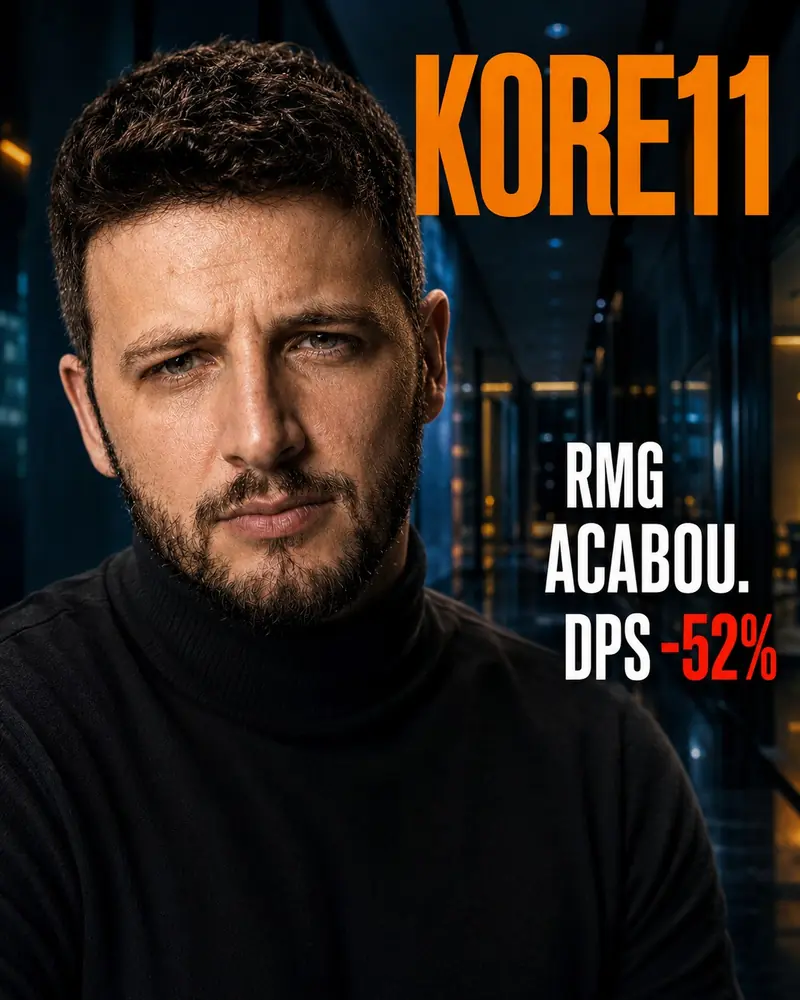
Update — 20/06/2026
Data from May/2026 (RG ID 1210017 + ClubFII community): a OI S/A returned 3 sets to Ed. Morumbi Office Tower, raising the physical vacancy of 2,82% to 4,52% (financial: 4,09%). The fund manager assesses as an opportunity — furnished and ready for immediate rental, with higher value rental potential. The result of May/26 without RMG fell to R$ 0,530/unit, requiring use of R$ 500 thousand from RMG reserve to complete the distributed R$ 0,60. Remaining RMG balance 1S26: R$ 0,685/unit. . Total accumulated reserve since IPO: R$ 0,51/unit. Monthly result detail 1S26 without RMG: Jan R$0,447 · Feb R$0,582 · Mar R$0,559 · Apr R$0,617 · Mai R$0,530 — average ZQX5ZX/unit.
Update — 29/05/2026
Data from April/2026 established via ClubFII community: a Physical vacancy has risen to 2,82% (was 1,86%) with the departure of the Cashew tenant from Ed. Alameda Santos, partially compensated by the entrance of Aspekto Health at Ed. Morumbi Tower (538m2). Even so, the result generated in Apr/26 was from R$ 0,64/unit — not using RMG — with distribution of R$ 0,60 and retention of R$ 0,04. The remaining RMG balance is R$ 0,74/unit. The accumulated half-year reserve until Apr/26 is R$ 0,13/unit. The 1Q26 report confirmed that Feb and Apr were operationally autonomous months (without RMG), with an average result of ~R$ 0,63/unit.
♪ The January cliff ♪
Current photo: May/2026
How the RMG anesthetized the dividend for 24 months
Guaranteed Minimum Income (RMG) is a common contractual mechanism in IPOs of brick FIIs. The seller of the real estate accepts to supplement the monthly distribution of the fund for a predetermined period, usually 18 to 36 months, so that the unit holder who entered the IPO sees a "full" yield since the first month — before the tenant portfolio is ripe, the contracts reach full adjustment and the vacancy of change is resolved.
In case of KORE11, the RMG was hired with the São Carlos Entrepreneuries (controlled by the Moreira Salles family) — the same company that sold the four buildings to the fund at the IPO in May 2023. The total value: R$ 93 million, paid in decreasing half-yearly instalments (ZQX0ZX mi per semester in 2024, ZQX1ZX mi per semester in 2025, and R$ 2 mi per semester in 2026, according to the Prospecto). In parallel, the KORE11 still owed portions of the acquisition of the property itself to the same São Carlos. The two streams ran together for two years. In December 2025, the KORE11 paid the last portion of the acquisition — R$ 281 million — and RMG entered its final line.
The effect of this engineering on the dividend presented to the market is mathematically direct:
of the 4 properties
São Carlos (RMG)
(artificial)
In R$ 93 million spread over 30 months 9,625 million shares, the grant even represented something between R$ 0,55 and R$ 0,75 per unit/month over the period — on average about distributed dividend 52%. . When RMG runs out, the dividend returns to the value that the pure real estate operation sustains: R$ 0,60. . It's not cut, it's revelation.
What RMG is (and why it exists)
The Guaranteed Minimum Income is not fraud. It is a legitimate mechanism, documented in the Prospect of public supply and audited normally. The delicate point is that it serves three simultaneous interests that are not always aligned with the long-term unit:
- For the seller (in the case, São Carlos), RMG is part of the sale price of the property — embedded in the value that the fund pays for the purchase. The seller receives more in sight, in exchange for complementing the distribution for some time. In terms of cash flow, it's funding disguised as collateral.
- For the IFI fund manager, the RMG gives time for the mature portfolio. It allows you to advertise competitive Yield in the IPO without having to show the wave of change, the still incomplete readjustments and the revitalization costs that the portfolio needs.
- For the unit who enters the IPO, the RMG creates the illusion of stable yield from day one. But when the grant is over, the investor discovers the real Yield — and it is usually smaller than the one that the offer release suggested.
The sophisticated unitholder reads the Prospecto, calculates how much of the distribution comes from RMG, projects the post-RMG dividend and decides with open eyes. The unitholder who bought KORE11 in 2023 looking at "DY 15% a year" in the ad discovered in January 2026 that that number was temporary.
The Time Line of Revelation
The initial offer of Kinea's fund priced the R$ 100 and promised yield of approximately 15% per year in the first years. The Prospecto detailed the RMG of R$ 93 million contracted with São Carlos — the seller of the four buildings — in half-yearly plots up to 2S/2026.
Throughout the period, the fund distributed R$ 1,25 per unit month after month. The management report separated the operational result from the RMG grant, but the headline released was only the total DPS — which hid how much of the distribution was temporary.
KORE11 paid the last R$ 281 million due to São Carlos for the purchase of the properties. The "Total Maintained for Liquidity Needs" dropped from R$ 67 million in Dec/2024 to R$ 5,7 million in Mar/2026 — equivalent to approximately 1 month of distribution.
In the management report of Dec/2025, the fund manager announced that from January the dividend would be adjusted to the sustainable level of the portfolio. The official guideline is R$ 7,20 to R$ 7,56 per year, or R$ 0,60 to ZQX3ZX per month. In January 2026 the fund distributed R$ 0,60 — and in February, March, April and May repeated the same number.
Kinea temporarily waived part of its remuneration, maintaining the overall rate at 0,98% a.a. until 31/12/2026. From 01/01/2027 the rate returns to 1,20% a.a. without the need for assembly — an automatic high of 22 bps that represents approximately R$ 1,5 million per year in expense, or about R$ 0,013/unit/month of additional pressure on the already reduced DPS.
The box covers 1 month
The fund ended March 2026 with R$ 5,7 million in cash maintained for liquidity needs. For an equity of R$ 1,02 billion, that's 0,56% PL — extraordinarily tight. With monthly distribution of R$ 5,77 millions (R$ 0,60 × 9,625 millions of units), the current mattress covers practically a single month DPS. Any unforeseen vacancy at Botafogo Enterprise, any extraordinary expense, any anchor contract reset — and the fund manager needs to choose between selling active or cutting again.
Similar cases: RMG ending as a default event
The KORE11 is not the first background to live that cycle, and it will not be the last. The winning RMG is a recurring event in brick FIIs launched in the last 5–7 years. It is worth comparing with known cases:
| Background | Segment | When the RMG was over | DPS Adjustment | Reaction pattern |
|---|---|---|---|---|
| KORE11 (Kinea Opportunities) | Offices SP+RJ | Dec/2025 | −52% (R$ 1,25 → R$ 0,60) | Quota collapsed from R$ 100 (IPO) to R$ 65 before the formal announcement. Market priced before the fund manager confirmed it. |
| HGRE11 (CSHG Real Estate) | Offices SP+RJ | Partial cycles 2019-2021 | Approx. −15% to −25% per cycle | Mature fund with staggered acquisitions — each winning new RMG generated smaller adjustment, partially absorbed by the increase in revenue from other positions. |
| BTAL11 (BTG Actual Agro Logistics) | Logistics / Shelf | Calendar 2027 (expected) | Still in progress — signage of the fund manager | Future case study: the fund has already signaled the adjustment in the report, anticipating expectation rather than surprising. |
| ALZR11 (Alianza Trust Income Real Estate) | Logistics / Joint Brick | Scaled cycles | Minimum (mature wallet) | Opposite case: Diversified portfolio and small RMGs — the maturity went almost unnoticed in the total DPS line. |
The pattern of extreme cases is the same: the unit falls before the formal announcement. . The market discovers RMG's calendar before the release. In the KORE11, the unit came out of R$ 100 (IPO in 2023) to R$ 65,82 in the third quarter of 2025 — a drawdown of approximately 35% priced before the fund manager confirm the new level in December. When the confirmation came, the reaction was small: the market already knew.
P/VP 0,65 — real discount or Yield trap?
R$ 69,00, the KORE11 negotiates with 35% discount on the equity value of R$ 106,13. This is statistically attractive — for brick backgrounds of comparable quality, medium P/VP revolves around ZQX0ZX-0,95. The argument of the supporters of the fund is simple: the properties are good, the vacancy is low, and the discount is exaggeration of the market.
The argument has partial merit. The four assets are real: Botafogo Business Centre (Beach of Botafogo, 300 – Rio de Janeiro) is an AAA set with anchor tenants such as Oncoclinics, Bradesco and Light, occupation of 97,55%, and represents 55% of the PL. O Morumbi Office Tower (Chácara Santo Antônio, SP) has 100% of occupation with Omnicom and ADM of Brazil. Alameda Santos (Av. ROCHESTER, CA (Spanish only), Coliseum, Coliseum Dr. Corporate Plaza (Chácara Santo Antônio, SP) complete the portfolio with vacancy between 2% and 4%. The consolidated physical vacancy of the fund is 1,86% — lower than the average office sector in SP, which is around 14,7%.
The counter-argument is more uncomfortable: P/VP bass only converges when the Yield justifies the discount, and the current Yield does not justify. . With Selic in 14,5% (May/2026) and IPCA+ Treasury in IPCA+7,3%, a DY of 10,4% on depressed unit of R$ 69 represents negative spread of approximately 407 bps against CDI gross-up in the short term. For the 35% discount to materialize as gain, it takes one of three things to happen:
- Selic drop below 11% — which reduces the post-fixed alternative and makes the Yield of 10,4% relatively attractive. BCB's Focus Bulletin projects Selic in 11% up to Dec/2026, so this vector is in progress, but it takes time to reach the pocket.
- The fund manager delivers increasing DPS — via readjustment of contracts by the IPCA (56,6% portfolio) and renegotiation upwards when current tenants renew. Possible, but the WAULT of 3,2 years means that only part of the contracts will be renegotiated in the next 24 months.
- The fund manager announces sale of asset with prize on VP — generating extraordinary depreciation or repurchase of units. But with R$ 5,7 millions and 55% PL concentrated in a single property, the sale of Botafogo would be restructuring, not smooth exit.
In other words: P/VP 0,65 is the correct pricing for a background with R$ 0,60 DPS and 14,5% Selic. . It's not cheap — it's fair. The discount only becomes effective gain if the macro scenario turns in favor.
The other 3 points which the report dilutes
1. Concentration of 55% in Botafogo Enterprise
O Botafogo Business Centre, in Rio de Janeiro alone represents R$ 559,5 million of R$ 1,02 billion PL — more than half of the fund. It is an AAA building with quality anchor tenants (Oncoclinics, Bradesco, Light), but the concentration is extreme for the patterns of the brick FIIs segment, where the expected is no asset to exceed 30-35% of the PL. Any termination of an anchor contract — in particular Oncoclinics, which occupies a large part of the ABL — has a disproportionate impact on the already lean DPS.
Add up: the bottom is 100% concentrated on the Rio-São Paulo axis, without geographical diversification outside these two cities. In a country where the premium office cycle has distinct regional dynamics (and Rio has been performing below SP in the last 5 years), this is additional exposure.
2. Mix 57% IPCA / 43% IGP-M in readjustments
The contracts of the KORE11 are readjusted into 56,6% by IPCA and 43,4% by IGP-M. . When the IGP-M accumulates deflation or acceleration distinct from the IPCA — as occurred at various times of 2023 and 2024 — there is real detachment of revenue. In May/2026, 12-month IGP-M is around 3,5% and IPCA around 4,1%, generating smooth portfolio pressure. For a bottom with lean box and tight DPS, any percentage point of compressed revenue turns to tension.
3. Rate rising automatically in 01/01/2027
Kinea temporarily waived part of its remuneration and the overall rate is in 0,98% a.a. up to 31/12/2026 (renewed by regulation change in 31/12/2025, Doc ID 1074020). From 01/01/2027, the rate automatically returns to 1,20% a.a. on market value — a rise of 22 bps without the need for assembly. In an operation that distributes R$ 0,60/unit, this increase represents approximately R$ 1,5 million per year of additional expenditure, equivalent to R$ 0,013/unit/month of pressure on the DPS. It's not catastrophic, but it's more of a wind against scheduled for January 2027.
For whom KORE11 the R$ 69,00 still makes sense — and for whom not
| Profile | KORE11 to R$ 69,00? | Why? |
|---|---|---|
| Very long-term investor (10+ years) who bets on premium office cycle recovery | Accumulates gradually | P/VP 0,65 on premium portfolio is attractive entry. Selic falling + IPCA readjusting contracts + portfolio maturation = re-rating potential in 24-36 months. But it's a patience thesis. |
| Who seeks predictable monthly income for retirement supplement | Don't buy it now | R$ 0,60 DPS over R$ 69 unit is 10,4% DY — lower than Selic gross-up Treasury (12,3%) and medium bank CDB with FGC. Other HG paper FIIs deliver more with less volatility. |
| Cotista who bought in IPO the R$ 100 believing in R$ 1,25 stable monthly | Accept reality or rotate | R$ 1,25 DPS won't come back. The R$ 69 with monthly R$ 0,60, the original yield-on-cost was in 7,2% over R$ 100 — below the current CDI. Accept loss peacefully or exchange for HG paper. |
| Who seeks exposure to premium brick with Kinea management | Consider, but with controlled size | It is Kinea's cheapest vehicle (P/VP) in brick. It makes sense as small position (3-5% from FIIs wallet) to diversify between paper and brick from the same fund manager. |
| Investor concerned with portfolio asset concentration | No — prefer HGRE11 or XPLG11 | 55% of the PL in a single property (Botafogo/RJ) is too high exposure. Funds with 20+ real estate distribute operational risk without losing quality. |
| Beginner who saw headline "FII paying 17% from DY" | No — DY 12m is a photo of the past | The DY 17,97% that appears on query sites includes months with RMG still active. The real prospective DY is 10,4%. It's expensive to confuse them both. |
5 milestones to follow in the next 12 months
- Stability of the DPS in R$ 0,60 — the official guideline of the fund manager is R$ 7,20 to R$ 7,56 per year. If the fund manages to deliver R$ 0,60 every month for 12 consecutive months without cutting again, the thesis of R$ 0,60 as "new floor" consolidates and the market can reduce the discount.
- Selic and Focus Bulletin Trajectory — additional cut of 25 bps is already priced for the Copom meeting in June 2026. The path of Focus towards Selic 11% by the end of the year compresses the post-fixed alternatives and makes the Yield of 10,4% relatively more attractive.
- vacancy of Botafogo Enterprise — Any movement of Oncoclinics, Bradesco or Light in the building is relevant fact. The contract with Oncoclinics, in particular, is what sustains much of the income of the asset that is worth the fund's 55%.
- Re-adjustment of contracts by IPCA in 2026-2027 — 56,6% of contracts are corrected by IPCA. With inflation expected between 4,0% and 4,5% over the next 12 months, this readjustment can add up between R$ 0,02 and R$ 0,03/unit/month to DPS — it doesn't change the game, but it helps compensate for the high rate in 2027.
- Signaling on new issue or sale of assets — with a R$ 5,7 million box, the KORE11 has no margin for relevant investments without new capture. If the fund manager announces emission to P/VP < 1,00, it will be dilution. If you announce the sale of peripheral property, it's constructive movement. Accompany relevant facts.
? Analytical Verdict
O KORE11 is a premium brick base of Kinea with four real buildings in SP+RJ, physical vacancy of 1,86%, institutional management above average and P/VP of 0,65 — discount of 35% on the equity value. It is a portfolio that exists, generates cash and has quality comparable to other HG office FIIs in the market. The premium discount brick thesis is still standing.
The problem is the same as it has existed since the IPO, but only now has it become visible: the actual operation yield is R$ 0,60/unit, not R$ 1,25. . The RMG subsidy of R$ 93 million paid by São Carlos sustained an artificial DPS for 24 months and masked the fact that, over a portfolio that is worth R$ 1,02 billion, the monthly net distributable revenue is in the order of R$ 5,77 million — generating 10,4% per year over a unit already compressed to R$ 69. With Selic on 14,5%, this yield does not hit CDI gross-up, and the spread is negative in the short term.
For the long-term unitholder (10+ years) who bets on the recovery of the premium office cycle, KORE11 to R$ 69 is defensible entry — provided that size is controlled, that the concentration of 55% in Botafogo is understood and that the expectation is calibrated to 10-12% to the year of total return, not 15%. For those seeking predictable monthly income or even compared to the artificial Yield of R$ 1,25 that existed until December, realignment of expectation is part of the work to do now — before buying more, not later.
The statement that needs to be said
RMG is not the seller's kindness. It's precified anesthesia. Whoever bought KORE11 from R$ 100 in May 2023 believed to be locking 15% a year, actually bought a yield with an expiry date printed on Prospecto — just didn't read the calendar. São Carlos was not giving money: it was distributing, over 30 months, part of the price it received for the properties sold. The IPO unit holder paid R$ 100 for a unit whose market VP is R$ 106 today, received R$ 30 in distributions during active RMG, and now holds an asset that negotiates R$ 69 with Yield of 10,4%. The original investor's closed account in almost three years: R$ 100 came out, R$ 30 came back in dividend, and the asset is R$ 69 — nominal loss of approximately 1%. In the same period, Selic yielded at least accumulated 35%. Who bought KORE11 in IPO subsidized the sale of the properties to himself, with real opportunity rate.
Where to dig
- Full analysis of the KORE11 (all indicators, graphs, valuation, institutional dossier V3)
- KNCR11 — when the unitholder discovers what is under the painting
- ABCP11 — When the unit holder finds out what he was buying
- See all FIIs analyzed
