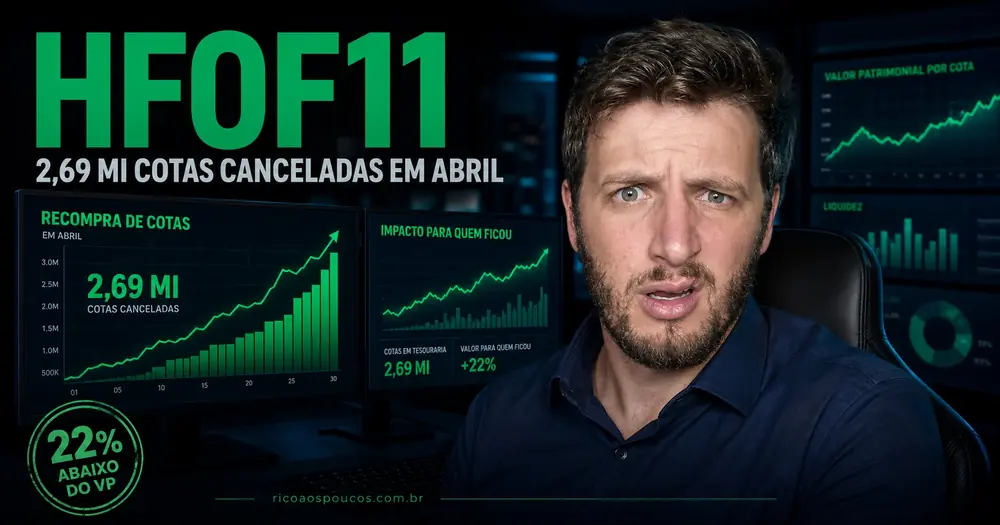
What's going on, in a sentence
Repurchasing units from HFOF11 accelerated in April/2026 and already consumed 75% from the authorised limit until August. Each unit cancelled the 18% below the VP transferred value to those who stayed — and the effect appeared on the balance sheet: the VP per unit rose from R$ 7,92 to R$ 7,97 in one month. Who is in today loads an asset with 32% discount added (HFOF -22% + FIIs invested -14%) without having to hit Selic timing.
What the buyback does to your pocket
Repurchase of unit is not the fund manager's kindness. It's math. When the HFOF11 buys a unit to R$ 6,53 (April average) that is worth R$ 7,97 in equity, it cancels the unit and absorbs the difference of R$ 1,44 — this gain is diluted among all the unit holders who remain in. In April there were 2,69 million cancelled units, against a previous monthly average of about 900,000. The acceleration is evident.
The program is valid until August/2026 and the HFOF11 It was the first FII of Brazil implementing unit buyback — it is not an experiment, it is a recurrent strategy of the house. With 75% of the limit already used in May, there are four months and little authorized space left. If the assembly approves a new round, the effect will continue; if not, the catalyst will disappear in the third quarter.
The double discount of 32%: which changes if IFIX recovers
The central argument of the HFOF11 Today is not 11,6% DY. It's the stacked discount structure. You buy the quote from R$ 6,21 when its equity is worth R$ 7,97 — discount from 22,1%. But the heritage of HFOF11 it is formed by other FIIs that also negotiate below the VP, with an estimated average discount of 14% by the fund manager. Multiplying the two discounts, the unit of HFOF11 is in practice buying the underlying real estate and papers with approximately 32% discount on the real value.
The upside of 47% to the potential unit is not optimistic projection — it is simply what would happen if the FIIs within the portfolio returned to the VP and the HFOF11 I'm sorry, too. Does not require Selic in 8%, does not require aggressive cutting cycle. It requires normalization. In 2025, with worse scenario at several times, the fund delivered 26,96% against IFIX 21,15% — the ability to capture turning movements has already been demonstrated.
DPS R$ 0,060: sustainable or has a shelf life?
The current R$ 0,060/unit DPS rose from R$ 0,056 in January/2026 and is officially above the R$ 0,058 FFO — that is, the fund manager is paying R$ 0,002/unit more than it generates from recurring cash. The classic warning signal would be unsustainable distribution, but the accumulated reserve of R$ 0,108/unit covers more than 50 months at this rate. There's no short-term squeeze.
The history helps to calibrate expectation: in 2024 the equivalent DPS was R$ 0,063 (adjusted by split 1:10 April/2025), fell to R$ 0,056 during the adverse cycle of 2025 and returned to R$ 0,060 now. The movement is cyclical, not structural. If Selic gives in and the invested FIIs resume integral distributions, FFO surpasses the current DPS effortlessly. If Selic stops at 14,75% all over 2026, the reservation holds the payment — but the floor is at R$ 0,056-0,058 in a bad setting, not at zero.
The elephant in the room: 50% intra-house
Approximately half of the assets of the HFOF11 is allocated to FIIs administered by Hedge Investments itself. The top five positions make this explicit: HLOG11 with 13,9%, TVRI11 with 10,2%, HREC11 with 9,4%, HAAA11 with 8,8% and HGBS11 with 8,7%. Four out of five are back of the house.
This means double layer of fees in the intra-house piece: the unit pays 0,60% a.a. administration fee in the HFOF11 plus the rate of each FII Hedge invested (estimated average of ~1% a.a.). The actual effective cost of the intra-house pocket comes to 1,5–2,0% a.a., not the 0,60% announced in the display. The total cost remains competitive against other FoFs, but it is important to understand that the rate of 0,60% is the smallest visible layer, not the total that comes out of the pocket.
Hedge Opportunities (jul/2025)
The structure created in July/2025 adds a layer of complexity to the look-through of the portfolio: part of the exhibition of HFOF11 to HJCT11 passes through a related vehicle using indirect leverage. For the unit holder this means that the "Diverse FoF" has a non-trivial fraction of exposure to structures with amplified risk — and this fraction does not appear directly in the standard monthly newsletter. Tracking the Structured Monthly Report (CVM) is mandatory.
Comparative with other FoFs on the market
| FoF | Admin Rate | P/VP | DY 12m | Active repurchase |
|---|---|---|---|---|
| HFOF11 | 0,60% a.a. | 0,78 | 11,6% | Yes. (75% of the limit used) |
| BCFF11 | 0,90% a.a. + perf | ~0,80 | ~11,2% | No, I don't. |
| RBRF11 | 0,80% a.a. + perf | ~0,82 | ~11,4% | No, I don't. |
| KFOF11 | 0,92% a.a. + perf (CDI) | ~0,84 | ~10,9% | No, I don't. |
O HFOF11 delivers the lowest explicit administrative rate of the segment, the highest discount on the PV and is the only one with active repo program among relevant pairs. The counterweight is the intra-house conflict that competitors do not have in the same magnitude. There is no FoF without trade-off; there is trade-off that fits your thesis or not.
What to observe in the coming months
- Repo limit until August/2026. With 75% already used, there are about 900,000 authorized units left. If the fund manager asks the assembly for further authorisation, the catalyst will continue; if not, the mathematical lever will disappear in the third quarter.
- DPS: maintenance of R$ 0,060 or new step. The FFO needs to climb from R$ 0,058 to something between R$ 0,062 and R$ 0,065 for the dividend to be sustainable without reserve burning. That depends on the FIIs invested to raise distribution.
- Selic and the Copom calendar. In 14,75%, the headwind is structural. Every 100 bps of cut reopens flow to FIIs and closes the P/VP gap — without it, the discount is frozen even with intact foundation.
- April/2026 Structured Monthly Report. Latest document detailing exposure via Hedge Opportunities and look-through portfolio. This is where the indirect leverage that the simplified newsletter hides appears.
. Analytical Verdict — Note 7,1 (CUMULAR)
The management is using the discount as a mathematical lever: each unit recompensed to -18% on the VP fatten the assets of those who stayed, and the effect appeared in just one month with the VP leaving R$ 7,92 for R$ 7,97. With Selic in 14,75%, there is no immediate catalyst for closing the 22% gap — but the buyback is the most honest way to return value to the unit holder without depending on the mood of the market. The cost of intra-house exposure (~50% PL, effective cost of 1,5–ZQX2ZX a.a.) is real and weighs against; the Hedge Opportunities structure adds opacity that needs monitoring. Even so, a fund that operates with 32% plus discount, lower segment administrative rate and only active repo program among relevant pairs has difficulty being ignored by rational quotaist — and those who bother with the intra-house structure have BCFF11 and RBRF11 as more expensive alternatives, without buyback and with lower discount. The choice is not comfortable; it is mathematics.
