. Update — 20/05/2026
The RG ABR/2026 revealed that R$ 0,90/unit distributed, R$ 0,70 were non-recurrent — CRI's early prepayment premium. The result Relevant was approximately R$ 0,77/unit. . Without a new event, the next DPS should return to the track R$ 0,75-0,80. . Also: CRI Echer (0,58% PL) had its donation agreement in payment signed and is in the implementation phase (May/26) — leaving the category "in negotiation".
. Update — 10/06/2026
O BTHF11 (BTG Actual Real Estate Hedge Fund, ~R$ 2,1 Bi under management) increased position in IRIM11 for ~9,5% from your wallet (~R$ 200M). . The management cites the thesis of the "double discount" — the IRIM is discounted, and the FIIs in its portfolio as well — and bet on return from IRIM11 to IFIX as a technical catalyst for buyer flow. The IRIM came out of the index after the mercer of Nov/2025; the re-entry, when it occurred, would bring buying pressure of passive funds. Quotation at 10/06: R$ 66,11 P/VP: 0,78.
What's going on, in a sentence
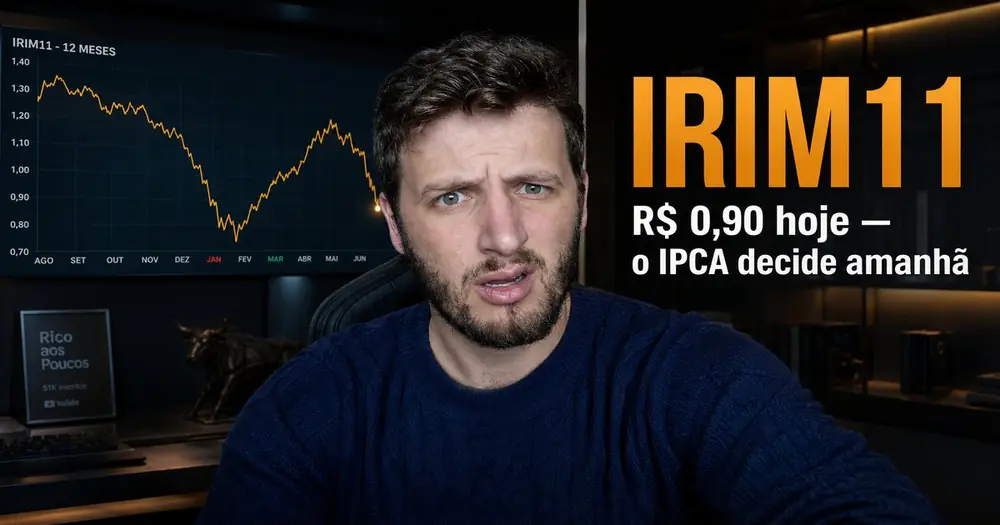
O IRIM11 paid R$ 0,90/unit in 19/05/2026 — largest DPS since the mercer with IRDM11. But the oscillation of 30% against the R$ 0,69 of Jan/26 is not the fund manager's merit: it is the IPCA of 157 indexed CRIs (72% of the PL) entering the result of the following month. If IPCA slows down, DPS returns to the R$ 0,70-ZQ1ZQX track without warning. 0,78 P/VP gives 22% discount — real, not trap. But Yield's expectation needs to be calibrated for the inflation cycle, not for the peak of a month.
Am I going to win or lose money with IRIM11?
That is the first question of any unit holder — and the direct answer is: will win real DY between 12-16% depending on the monthly IPCA, and purchase with 22% discount on VP which may (or may not) be carried out as the fund manager recycles the portfolio of legacy FIIs of the IRDM11. Below is the numerical photo:
. The IPCA decides — not the fund manager
72% of IRIM11 PL is in 157 IPCA-indexed CRIs with mean MTM rate of IPCA+10,3% and duration of 3,46 years. When the IPCA rises, the monetary correction enters the result of the following month and becomes DPS. When the IPCA falls, the effect is symmetrical. There is no fund manager who can avoid this mechanism — the index decides. In Jan/26, the IPCA out-nov/25 was in 0,09% and 0,18% (weakest of the year), and the DPS dropped to R$ 0,69. In Apr/26, the IPCA of Mar/26 returned to 0,32% — and the DPS rose to R$ 0,90. If you believe that IPCA is above 0,25%/month for the next 12 months, the real DY is between 14-16%. If it slows down, it drops to 12-13%.
The complete post-merger table (November/2025 onwards, base of 35,2 million units) reveals the pattern:
| Competence | DPS (R$) | IPCA ref. | Payment | Remarks |
|---|---|---|---|---|
| ten/25 | 0,89 | 0,33% | 13/jan/26 | Includes ZQX0ZX accumulated reserve |
| Jan/26 | 0,69 | 0,09% / 0,18% | 13/feb/26 | IPCA out-nov/25 weak — lower post-merger DPS |
| Feb/26 | 0,80 | 0,33% | 17/Mar/26 | IPCA Dec/25-Jan/26 Recomposes Correction |
| Mar/26 | 0,75 | 0,24% | 17/Apr/26 | Cumulative reserve of R$ 0,03/unit |
| Apr/26 | 0,90 ★ | 0,32% | 19/May/26 | Major post-merger DPS — PAY TODAY |
Should I buy it now or wait?
That's the practical decision. Both sides of the account:
Argument to buy now: R$ 66,10, you buy R$ 84,38 of equity by R$ 18,28 less per unit — Real discount of 22% that tends to close as the fund manager finishes recycling legacy FIIs. In addition, it locks annualized DY between 12-16% (depends on IPCA), in a paper FII sprayed with 208.981 quotaists, PL of R$ 2,97 Bi and 0,98% rate without performance. The structure is solid — 157 different CRIs in debtors, regions and indexers. No leverage. The only real systemic risk is an IPCA close to zero for several months in a row.
Arguments to wait:
- DPS is volatile by construction. The oscillation of 30% (R$ 0,69 → R$ 0,90) in 4 months is the mechanical of the IPCA, not the fund manager. If you need predictable flow to cover fixed expense, brick fii with atypical contract better fulfills the paper. IRIM11 is IPCA proxy — use those who accept this volatility in exchange for the real Yiedd.
- Legacy SONS still weigh. 19% of PL is in FIIs — much of them inherited from the incorporation of IRDM11 in Nov/2025. Includes HCTR11, DEVA11, MANA11 and TORD11 — problematic assets that the fund manager is disinvesting. In Oct/2025 (before Merger), the negative result with FIIs was -R$ 2,3 Mi. In Mar/2026, new sales: CPSH11, EIRA11, RBHY11, HDOF11, TORD11. As long as the wallet isn't cleaned, months with loss sales will show up.
- IPCA deflation risk. If the IPCA drops to 0,10-0,15% per month for 6 months in a row, the DPS returns to the R$ 0,70-ZQ3ZQX track and the annualized DY is 12-13%. For paper FII without minimum guarantee, it is acceptable — but it is not what the current peak is pricing.
- High Selic favors direct competitor: IPCA+ Treasury. With Selic at a restrictive level, the long IPCA+ Treasury already delivers IPCA+7% to IPCA+7,5% at zero risk. IRIM11 delivers higher yet with risk of FII (volatility, market marking, legacy FIIs). Who accepts zero risk prefers the Treasury; who accepts asymmetric risk in exchange for yeld prefers the IRIM.
When you buy it, it makes sense:
- If you want IPCA exposure with real 12-16% yield and sprayed wallet (not well served with only 1 direct CRI).
- If you accept monthly DPS oscillation and look at total profitability on horizon 12-24 months.
- It is believed that the equity discount of 22% closes as the fund manager finishes recycling the inherited FIIs (horizont 12-18 months).
The schedule — when IPCA decides the case
The real decision point is every 10th of the month: the IPCA of the previous month released by IBGE determines, with 30-60 days of lag, the DPS of the following month. Tracking the index is equivalent to following the bottom box. There is no mystery in the formula — you just have to be aware.
What changed — post-merger composition IRDM11
O IRIM11 born of the incorporation of the IRDM11 November 2025. The current composition reflects the consolidated strategy of Iridium Asset Management:
- CRIs (157 operations) = PL 72%. Real diversification in debtors, regions and indexers. Mean MTM rate of IPCA+10,3%, duration of 3,46 years. This is the engine of the DPS — and the explanation of monthly volatility.
- FIIs (23 funds) = PL 19%. Mixture of strategic assets (competitors that add up to yield) with IRDM11 legacy in recycling process (HCTR11, DEVA11, MANA11, TORD11 — gradually deinvested). In Oct/2025 gave -R$ 2,3 Mi negative result; in Mar/2026 more sales (CPSH11, EIRA11, RBHY11, HDOF11, TORD11).
- Box / RF = PL 10% = R$ 315 Mi. Applied in BTG Fixed Income fund that yields with Selic/CDI and cushions CRI volatility. In Apr/26, the cashier jumped with CRIs receipts, contributing to record DPS.
- No leverage. Unlike paper FIIs that leverage via issuing senior shares or credit lines, IRIM11 operates 100% with its own PL. This reduces beta stress and eliminates risk of call capital.
- 0,98% rate a.a. without performance. Of the lowest in the segment — KNCR11 1,08% snake, HGCR11 1,20% snake. It means that the unit holder gets almost all the gross income from the portfolio.
Why the market discountes 22%
O IRIM11 negotiates R$ 66,10 with VP of R$ 84,38 — discount of R$ 18,28 per unit. In theory, who buys today takes R$ 84,38 of equity by R$ 66,10. In practice, the market puts into practice three risks justifying the spread:
Risk 1 — IPCA de-inflate: if the IPCA drops to 0,10-0,15% per month for several months, the DPS returns to the R$ 0,70-ZQ3ZQX track and the annualized DY is 12-13%. For paper FII without minimum guarantee, this is acceptable — but it is not what is priced in the apr/26 euphoria. Market is suspicious that the current IPCA is a passenger peak.
Risk 2 — Recycling of legacy FIIs: while the portfolio of FIIs inherited from IRDM11 is not fully liquidated, months with loss sales will appear in the result. The process is inevitable — and the market already expects that cost. Estimated horizon: 12-18 months to completion.
Risk 3 — Compared to IPCA+ Treasury: with restrictive Selic, the IPCA Treasury+ long delivery IPCA+7% to IPCA+7,5% with sovereign risk. IRIM11 delivers raw IPCA+10,3% in portfolio, but with beta of FII, market marking and management cost. In a risk aversion environment, some investors prefer the direct title and leave the IFI — by pressing the discount.
What to keep an eye on from now on
- IPCA May/2026 (disclosure on 10/jun). It will determine the DPS of Jul/26. If you stay above 0,25%, the DPS remains on the R$ 0,80-ZQX range. If it falls to 0,15%, it goes back to ZQX1ZX-0,75.
- Recycling speed of legacy FIIs. Follow in monthly management reports which FIIs were sold, at what price, and what balance remains. The faster sanitation, the faster the P/VP discount closes.
- Long-interest curve. If the long DI curve falls (market pricing Selic lower), the IRIM vs. Treasury IPCA+ spread becomes less attractive — and the CRI market marking goes up. A favorable movement for the current unit.
- New CRIs with attractive rate. In a pressured IPCA environment, new emissions rates tend to open. Follow if the fund manager can extend duration with IPCA+11% or IPCA+12% rates in the next 12 months.
- Absence of wallet. 157 CRIs is a big number. Follow in quarterly reports if there are late CRIs, provision for losses and what the impact on the PL. Today the wallet is healthy — any change becomes a sign.
? Analytical Verdict
O IRIM11 It's got a note. 7,7 · BUY with awareness of the mechanism. It is one of the best paper FIIs in Brazil in terms of spray (208.981 unit holders, PL R$ 2,97 Bi) and cost structure (0,98% a.a. without performance). The discount of 22% on VP It's real -- it's not a trap. Liquidity is suitable for any profile. What the investor needs to understand before entering: today's R$ 0,90 DPS no guarantee for the next few months. The April IPCA (0,32%) was the engine. If May and June slow down, the next DPS can be ZQX0ZX-0,80. The purchasing thesis does not change — but the income expectation needs to be calibrated for the inflation cycle, not for the peak of a month. Who you buy thinking you'll get R$ 0,90 every month is buying the peak. Who buys thinking you'll get real yeld between 12-16% for the next cycle is buying the right thesis.
